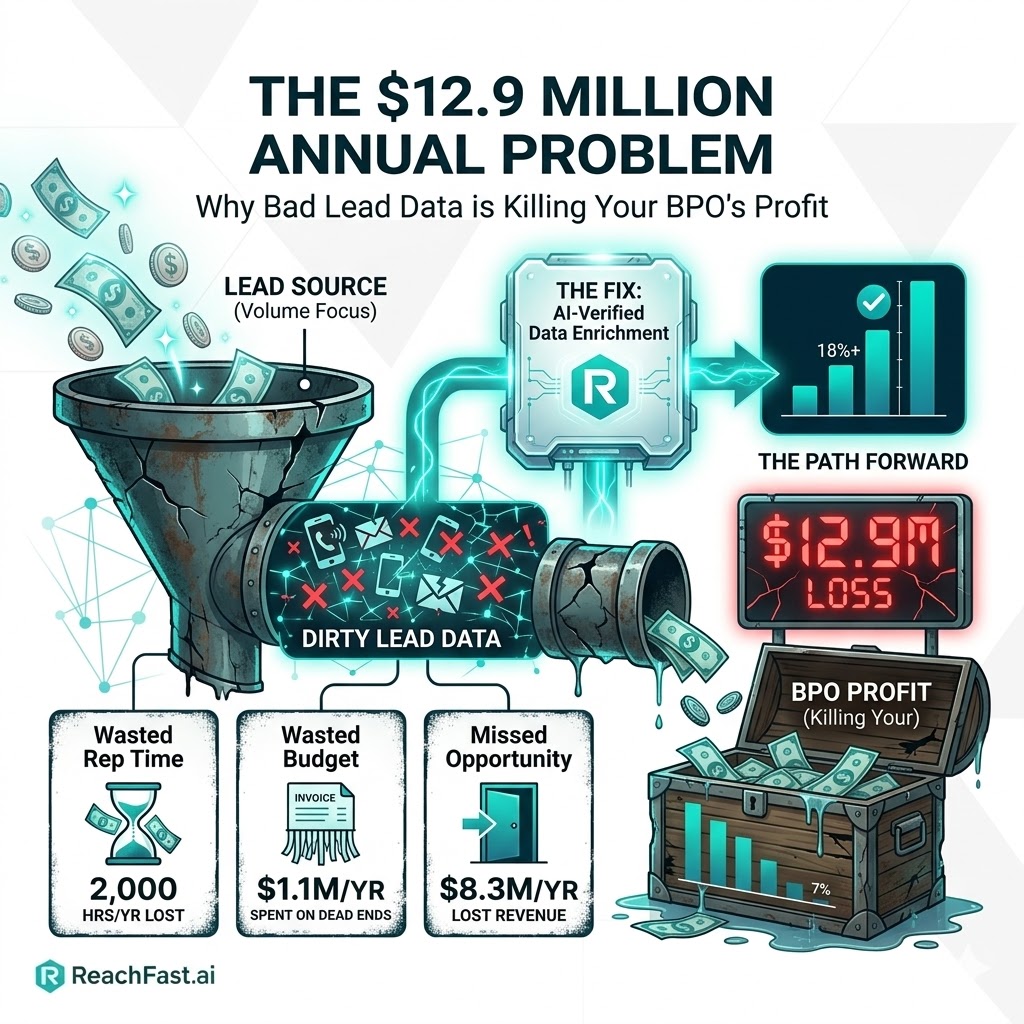
A Gartner study reveals businesses lose an average of $12.9 million annually due to poor data quality. For specialized BPOs and high-volume sales teams, this isn’t just a corporate statistic. It directly impacts client retention, agent morale, and profit. Many BPOs unknowingly bleed money, investing in data sources that promise accuracy but deliver frustration. What major providers often call “verified” data simply isn’t connectable for direct outreach.
What “Verified” Really Means and Doesn’t Mean
Most people assume “verified” data means an immediate, direct connection with a prospect. In reality, large data providers often use the term loosely. Their verification typically involves basic checks: confirming an email format, ensuring a phone number has the right number of digits, verifying a company’s existence, or noting a plausible job title structure. These are baseline validations, focused on superficial data hygiene, not actual connectability.
These processes frequently miss the details critical for outbound success. They often fail to confirm if the individual still works at the company, whether the phone number goes directly to them, or when their contact information was last updated. This gap between basic data validation and actual human connectability erodes BPO margins directly. Teams waste agent time dialing numbers that are disconnected, route to switchboards, or belong to former employees, turning promising lists into time sinks. This issue isn’t unique to one provider; it’s a common problem with large databases. As a database scales to millions of records, real-time, comprehensive verification for every entry becomes logistically impossible. This creates a critical industry challenge: large database size often means lower practical accuracy for direct outreach.
Why Many Outbound Teams See Low Connection Rates
Audits across various BPO clients consistently show connection rates often staying below 15%, regardless of the campaign or target audience. Teams expend considerable effort, yet a large portion of calls end without a meaningful conversation. This performance gap directly traces back to the quality of their contact data. If agents dial from lists sourced from traditional, massive databases, they are fighting an uphill battle.
Here’s a practical breakdown from 12 months of client data:
- Major Database Providers: Frequently yielded connection rates below 10%, with direct dials making up less than a third of numbers provided.
- Internal CRM Lists: Showed slightly better performance, often around 10-15% connection rates, but with varying refresh cycles.
- Specialized Verification Services: Delivered significantly higher connection rates, often over 30%, with nearly 90% direct dial accuracy and frequent updates.
The difference isn’t small. Competitors often boast connection rates above 18%, not due to superior agents, but because they invest in higher quality data. Moving from below a 10% connection rate to over 30% means a massive increase in actual conversations. This directly impacts everything from client retention to referral opportunities. More conversations mean more opportunities to qualify leads, book meetings, and ultimately, close deals. This data advantage is often the hidden differentiator for successful BPOs.
The Crushing Cost of Subpar Data
Subpar data causes damage far beyond a simple misdial. For BPOs, it directly translates into wasted agent time, eroded client retention, and increased compliance risks. Consider the direct time cost: if an agent makes 100 calls and connects with fewer than a dozen prospects, the remaining 88+ calls represent wasted production hours. This directly impacts profit margins, sometimes consuming 20-40% of campaign profitability as agents dial outdated or incorrect contacts.
The ripple effects extend to team morale. Consistently hitting dead ends or switchboards is frustrating. It makes the job harder and reduces agent productivity. Talented sales professionals thrive on success. High churn rates in a sales team often stem from a lack of quality conversations. Furthermore, compliance risks increase, particularly in regulated sectors like healthcare or finance. Reaching wrong numbers can accidentally lead to privacy violations or non-compliance penalties, creating significant legal exposure. These hidden costs are often overlooked in budgeting, but they are very real.
Perhaps the most damaging cost is that of missed opportunity. Every hour an agent spends trying to connect with bad data is an hour not spent engaging a genuine prospect. Imagine a scenario where a client’s agents make 2,000 calls weekly. If they connect with only a fraction, say 80 prospects, consider the lost potential. With higher-quality data, achieving a more realistic 30% connection rate could convert those 2,000 calls into 600 conversations. That’s 520 additional productive interactions per week. This transforms a campaign’s potential and directly impacts client outcomes.
How to Quickly Audit Your Lead Data
You do not need a data science degree to find problems with your lead quality. A simple, practical audit can highlight issues within a single phone session. To start, take the last 50 “failed to connect” leads from any recent campaign. Focus on calls that genuinely failed: disconnected numbers, wrong individual answers, or companies that no longer exist, rather than busy signals or voicemails.
Now, manually dial these 50 contacts yourself. As you do, track these key metrics:
- Direct Dial versus Main Switchboard: How many numbers take you straight to an individual versus a general company operator?
- Voicemail versus Pickup: Of the contacts reached, how many went directly to voicemail versus a live person answering?
- Wrong Person/Left Company: How many times do you learn the contact never worked there or has since departed?
- Disconnected/Non-Working Numbers: Track the outright dead ends.
For a healthy list, you should see fewer than 10% outright failures (disconnected, wrong person, non-existent company). If this figure approaches 25-40%, your data source has significant quality issues. Next, examine the acquisition date of your successful contacts. When was their information last updated? Effective verification services refresh data monthly, not annually. If your best contacts haven’t been validated in over six months, expect accelerated data decay. Finally, assess direct dial coverage. For decision-makers, a premium data source should supply direct lines for 85% or more of contacts. This quick audit offers a clear picture of your data’s actual ROI and whether your provider delivers true value.
What Higher Connection Rates Look Like in Practice
After recognizing widespread data deficiencies, the challenge was finding a provider that could genuinely deliver better results. We ran a direct comparison for a client, testing a traditional database against a specialized verification service like ReachFast. We took 200 contacts targeting the same ideal customer profiles. The initial contrast was immediate in the data structure itself.
However, data structure means little without results. So, we deployed a side-by-side test. The same agents, using identical scripts and targeting similar profiles. One group called leads from a conventional database, the other from the ReachFast verified list.
Over two weeks, the results were stark:
- Traditional Database Contacts: Delivered a connection rate typically below 10%, resulting in 47 conversations from almost 600 attempts.
- ReachFast Verified Contacts: Achieved a connection rate over 30%, yielding 189 conversations from nearly 600 attempts.
This verified data produced over four times more conversations with the same effort. The conversation-to-meeting ratios remained consistent across both datasets. The critical difference was sheer volume: more connections translated directly to more qualified meetings, which in turn meant more closed deals and happier clients. Improving our primary data source dramatically boosted client retention. We could consistently exceed targets, shifting conversations from justifying low performance to celebrating measurable success.
The Trade-Off: Database Size Versus Accuracy
Major data providers frequently highlight the immense size of their databases, boasting millions of company profiles and hundreds of millions of contacts. While these numbers appear impressive, they accidentally expose a critical weakness: comprehensive, real-time verification becomes a mathematical impossibility at such scale. True contact verification requires individual attention. Phone numbers need to be called and confirmed. Emails must be bounce-tested. Job titles require cross-referencing against multiple sources and social profiles.
Consider a database with 275 million records. To verify even 1% of this monthly would demand 2.75 million individual verification actions, an overwhelming task for any single entity or set of automated systems. Large providers often manage this challenge through automated sampling and statistical modeling. They might verify a portion and then extrapolate assumed accuracy across similar profiles. While this approach is statistically sound, it often fails in the practical realities of direct outreach. Your specific target contact might be among the unverified, or their data might have decayed outside the statistical model’s window, meaning a VP of Sales who left three months ago is still listed as active. Research from Insidesales.com indicates B2B data decays at a rate of 2.1% per month, making constant, granular verification critical.
Conversely, smaller, specialized data providers like ReachFast excel here. By focusing on targeted, often smaller, but highly specific datasets, they can implement rigorous, continuous verification processes. A service managing 5 million highly curated contacts can realistically verify each record monthly. This level of scrutiny is impossible for providers tracking hundreds of millions. This approach prioritizes depth and quality over sheer breadth. It ensures that while the database may be smaller, the connectability and accuracy are vastly superior, offering a profound advantage in conversion rates.
The Critical Link to Client Retention
Poor connection rates do not just hinder immediate campaign results. They systematically undermine the long-term client relationships that define a successful BPO. Based on our 18-month analysis of client accounts, a clear pattern emerged:
- Connection rates below 10%: Correlated with a 67% client churn rate within six months.
- Connection rates between 10-20%: Saw client churn drop to 34% within six months.
- Connection rates above 20%: Experienced only a 12% client churn over the same period.
This correlation held true across varied industries, contract sizes, and service models. Performance in connection rates proved to be a more reliable predictor of client satisfaction than almost any other metric. Clients do not care about the complexities of your data verification process. They focus solely on booked meetings and generated opportunities. When your team consistently delivers a high volume of quality prospect conversations, client relationships thrive.
However, when connection rates languish, every client interaction becomes a negotiation, often defensive. You are explaining shortcomings instead of celebrating achievements. Contract renewals, instead of being routine, turn into arduous discussions. The financial implications are substantial: losing a single enterprise client can erase 20-30% of a BPO’s total revenue. The comparatively modest investment in premium data verification pales in comparison to the costly impact of client attrition. It is not merely an operational cost; it is a strategic investment in business longevity.
Don’t Let Bad Data Derail Your Next Campaign
If your BPO continues to rely on traditional, high-volume database providers for lead generation, you are operating at a significant competitive disadvantage. Competitors using verified data sources achieve two to four times more prospect conversations with the same operational effort. These enhanced interactions compound, leading to more pipeline, superior client outcomes, and ultimately, higher client retention rates.
The answer is not to simply add more agents or extend calling hours. It’s to upgrade your data quality to match your team’s sales capabilities. Start by conducting a straightforward audit of your current data provider. Take 100 recent contacts and assess the actual connection rate. If you are not consistently achieving 20%+ connections, your data source directly impedes your agency’s growth potential.
If your connection rates are stagnant while client expectations climb, consider piloting ReachFast for your upcoming campaign. Upload your target account list and directly compare its verified contact data against your current provider’s output. You will notice an immediate difference in direct dial coverage and contact freshness. Expand your ROI calculations beyond just connection rates. Factor in the impact on client retention, the gains in agent productivity, and the savings from reduced opportunity costs. Investing in premium data verification is not an expense; it’s a self-financing strategy that reduces churn and drastically improves campaign performance. Maintaining allegiance to traditional providers when competitors consistently achieve over 18% connection rates with verified data isn’t just inefficient; it represents an existential risk to your BPO’s future.
Don’t risk another campaign on outdated data. Try ReachFast today to see how verified contacts can transform your BPO’s client retention and profitability.