In some BPO operations, a high percentage of outbound calls may go to voicemail, wrong numbers, or dead air, indicating poor data quality.
Meanwhile, your biggest competitor is booking 3x more meetings from the same call volume and charging premium rates.
The gap isn’t talent. It’s data.
I’ve watched BPO operations hemorrhage clients because their connection rates flatlined at 7-10% while competitors cruise at 15-25%.
The dirty secret? Your data provider is sabotaging every dial.
Why Your Connection Rates Trail Competitors by 60%
Most BPO leaders blame agent performance when connection rates stagnate. They’re looking in the wrong place.
The real culprit lives in your CRM. Dirty data forces your agents to waste 2-4 hours daily verifying contacts, chasing outdated phone numbers, and scrubbing duplicates. That’s 50% of their shift spent on data cleanup instead of connecting with prospects.
Here’s what separates winners from losers:
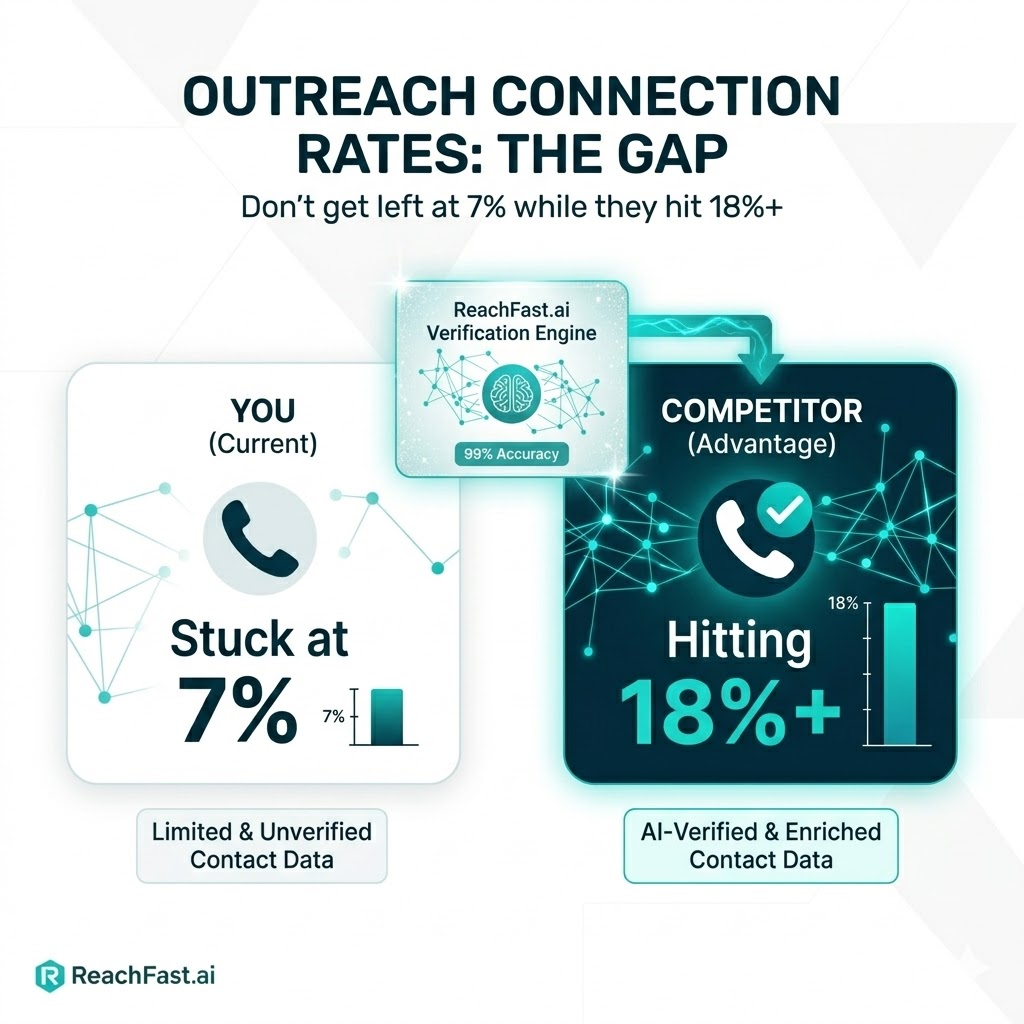
Underperforming BPOs: 7% connection rates using generic databases
Top-tier competitors: 18% connection rates using validated, enriched data
One BPO operation generated 2,316 leads, converted 1,048 to marketing qualified leads, and booked 832 meetings in a single quarter. They averaged 23 sales meetings monthly because every number they dialed was verified and current.
The math is brutal. If your team makes 500 calls daily at 7% connection rates, you reach 35 prospects. Competitors hitting 18% reach 90 prospects from the same effort. That’s 55 additional conversations daily, 1,100 monthly, 13,200 annually.
Those extra connections compound into pipeline velocity your clients notice.
Poor data quality creates a cascading failure across your entire operation. Agents lose confidence after hitting disconnected numbers all morning. Morale drops. Turnover increases. Your best performers leave for competitors with better tools.
The opportunity cost multiplies when you consider that BPO can save 15-30% on average versus in-house costs, but dirty data wipes out those gains through inefficiency. You’re competing on price while delivering subpar results.
What Happens When BPO Connection Rates Stay Low?
Client retention becomes impossible when your performance lags competitors by this margin.
Enterprise clients walk away from BPO partnerships after three months of subpar results. One manufacturing company terminated their agreement when their BPO delivered 340 qualified leads in Q1 while a competitor pitched 800+ for the same budget.
Poor connection rates create a cascade of problems:
- Extended sales cycles with first-call resolution rates dropping to 70-79%
- Inflated costs as agents spend more time per lead
- Quality perception issues where clients assume poor targeting
- Competitive disadvantage as competitors bid more aggressively
The BPO market is exploding. We’re looking at $328.37 billion in 2025, projected to hit $695.77 billion by 2033 at 9.9% CAGR. Customer service BPO is growing fastest at 11.2% CAGR, driven by e-commerce and omnichannel support demands.
But only providers with superior connection rates will capture that growth.
Large firms with $5B+ revenue dominate 53% of BPO spend at $72.9 billion, but mid-market companies ($50M-$1B) represent 25.2% at $34.8 billion. These mid-market clients are most sensitive to performance gaps because they have options.
When your connection rates underperform, clients don’t just leave. They tell others. Reputation damage spreads faster than you can acquire new accounts. The BPO industry runs on referrals and case studies. Poor performance creates negative word-of-mouth that takes years to overcome.
Many BPO contracts include performance clauses, making consistent delivery crucial for client retention.
How Dirty Data Kills BPO Performance
Your data provider is your biggest operational risk.
Poor data hygiene often results in inaccurate contacts, outdated numbers, and duplicates, diverting agents’ time from high-value tasks. Phone numbers get disconnected, decision-makers change roles, companies restructure. Without real-time validation, your agents dial into the void.
Here’s what happens with dirty data:
Morning drill: Agent pulls 100 contacts for outbound calls
Reality check: 30-40 numbers are wrong, disconnected, or irrelevant
Time waste: 90 minutes spent researching correct contacts
Actual productivity: 3-4 hours of selling time becomes 1-2 hours
Meanwhile, competitors using validated datasets start their day with confidence. Every number connects. Every conversation has potential.
The opportunity cost is massive. Your best agents burn out from frustration. Client results suffer. Competition increases pricing pressure because they’re delivering measurable superiority.
Top BPO providers switch to vetted data sources with AI validation, RPA for processing, and CRM integration to prioritize live connections.
The fix isn’t hiring better agents. It’s feeding them better data. I’ve watched BPO teams transform overnight when they switch to validated data sources. Connection rates jump from 7% to 18% within the first month. Agent morale improves dramatically. Client retention follows.
Average speed of answer targets should hit 20-30 seconds to reduce abandonment rates. But that metric becomes irrelevant when half your calls go to dead numbers. Clean data makes every operational metric more achievable.
The True Cost of Low BPO Connection Rates
Let’s run the numbers on what 7% connection rates actually cost your operation.
A typical BPO agent makes 400-500 calls daily. At 7% connection rates, that’s 28-35 conversations. Compare that to competitors hitting 18% who generate 72-90 conversations from the same volume.
Revenue impact per agent:
- Low performer: 35 daily conversations × 2% close rate × $500 average deal = $350 daily revenue
- High performer: 90 daily conversations × 2% close rate × $500 average deal = $900 daily revenue
That’s a $550 daily gap per agent. Multiply by 20 agents and you’re losing $11,000 in potential daily revenue. Monthly, that’s $220,000 in missed opportunity.
But the real damage hits client relationships.
Clients don’t care about your operational challenges. They measure results.
When your BPO delivers 100 qualified leads monthly while competitors promise 250, you’re fighting an unwinnable battle.
| Scenario | Connection Rate | Monthly Leads | Client Retention Risk |
|---|---|---|---|
| Current State | 7% | 100 leads | High (3-month churn) |
| Competitor Level | 18% | 250 leads | Low (12+ month retention) |
| Top Tier | 25% | 350 leads | Minimal (multi-year contracts) |
Your operational costs stay the same whether you deliver 100 or 250 leads. Better data quality is pure margin expansion.
The compounding effect of poor connection rates extends beyond immediate revenue loss. Your cost per lead increases as agents spend more time generating the same results. Marketing costs rise as you need more prospects in your pipeline to hit client targets. Overhead allocation per successful outcome becomes unsustainable.
Client lifetime value drops precipitously when connection rates lag. Enterprise accounts that should generate $500K+ annually become break-even propositions when performance disappoints. Renewal rates plummet. Account expansion becomes impossible.
The competitive pricing pressure intensifies as well. When competitors deliver superior results, they can charge premium rates while you’re forced to compete on price. Your margins erode while their margins expand. The performance gap creates a financial death spiral.
How Top BPO Providers Hit 18%+ Connection Rates
The best BPO operations treat data as their primary competitive weapon.
They partner with providers delivering high-quantity, high-quality leads with real-time validation. Every contact includes verified phone numbers, current job titles, and recent company intelligence.
What separates elite performers:
- AI-powered validation with phone numbers verified within 24-48 hours
- Intent signals prioritizing prospects showing active buying behavior
- Compliance monitoring with automated scrubbing preventing violations
- CRM integration ensuring clean data flows directly into agent workflows
One tech services BPO saw their pipeline grow 3x faster and cost-per-lead drop 65% after switching providers. They went from struggling for client renewals to commanding premium pricing.
The operational transformation was immediate.
Agents started their shifts with confidence instead of frustration. Call quality improved because conversations happened with qualified prospects, not wrong numbers. Client satisfaction jumped as results became predictable.
Elite BPO providers also optimize around connection quality, not just quantity. They focus on speed of answer targets of 20-30 seconds to reduce abandonment rates. First-call resolution becomes achievable when agents reach the right people with relevant information.
The best operations implement systematic follow-up automation that re-engages prospects without manual effort. They use RPA for data processing and CRM integration. Every technological advantage compounds into superior client outcomes.
The data infrastructure makes the difference. Top performers don’t just buy better lists. They invest in systems that continuously validate, enrich, and prioritize prospect data. Their agents work with intelligence while competitors work with guesswork.
Finance and accounting BPO represents 21.4% of the market in 2025, with 12.6% of total spend driven by RPA and AI automation demands. CRM BPO captures 19.9% of $138.3 billion in annual spend, focused on multilingual customer experience and AI chatbot integration.
Why BPO Data Quality Determines Client Retention
Your clients don’t renew based on effort. They renew based on results.
When a manufacturing client needs 500 qualified leads quarterly, they’re not impressed that your team made 10,000 calls. They care about the 500 leads. If competitors deliver those leads from 5,000 calls, your operational efficiency becomes irrelevant.
Client retention follows a predictable pattern:
Month 1-3: Honeymoon period, clients evaluate initial results
Month 4-6: Performance comparison against benchmarks and alternatives
Month 7-12: Renewal decision based on ROI and competitive landscape
BPO providers with superior connection rates build momentum early. Their clients see immediate value. Renewal becomes automatic because switching providers introduces risk.
Low-performing providers fight for survival every quarter.
The retention cliff is steep. Once clients identify performance gaps, they start shopping alternatives. Your operational costs remain fixed while revenue drops. Recovery requires new client acquisition, which takes 3-6 months minimum.
The math becomes brutal during renewal negotiations. Clients compare your 100 monthly leads against competitive proposals promising 250. They calculate the opportunity cost of staying with underperformers. Price concessions can’t compensate for performance gaps this large.
Consider the reference risk as well. Satisfied clients become your best sales tool, providing case studies and referrals. Disappointed clients become roadblocks, sharing negative experiences with prospects. Your reputation spreads faster than your marketing can control.
Enterprise accounts that represent 30-40% of your revenue base make retention decisions based on measurable ROI. They track cost per lead, conversion rates, and pipeline velocity. When your metrics trail industry benchmarks by significant margins, renewal becomes impossible regardless of relationship strength.
The replacement cost of lost clients extends beyond immediate revenue. New client acquisition requires business development investment, onboarding costs, and operational learning curves. Lost enterprise accounts often take 12-18 months to replace with equivalent revenue.
Building Your BPO Competitive Advantage Through Data
The BPO market rewards providers who deliver measurable superiority.
With customer services BPO growing at 11.2% CAGR and CRM BPO representing 19.9% of $138.3 billion in annual spend, there’s massive opportunity for providers who get this right.
Your competitive moat comes from consistent performance others can’t match.
Start by auditing your current data quality:
- What percentage of your database contains current, verified contacts?
- How much time do agents spend on data cleanup versus selling activities?
- What’s your true connection rate, measured as conversations with decision-makers?
Then benchmark against industry leaders who book 3x more meetings from the same call volume. Elite providers achieve their 50-70% cost advantage through operational efficiency, not just offshore labor arbitrage.
The transformation path requires systematic change:
Phase 1: Replace generic databases with validated data sources that eliminate 30-40% waste
Phase 2: Integrate AI validation systems ensuring phone numbers work before agents dial
Phase 3: Optimize workflows for connection quality over dial volume
Phase 4: Measure connection rates and decision-maker conversations, not activity levels
Market leaders in the BPO space command premium pricing because results justify investment. They operate in high-growth segments like finance and accounting (21.4% market share) where accuracy and compliance matter most.
The technology gap creates sustainable competitive advantage. While competitors struggle with dirty data, you’re delivering predictable results. While they fight for renewals, you’re expanding existing accounts. While they compete on price, you compete on performance.
The operational leverage compounds over time. Better connection rates improve agent retention. Higher client satisfaction drives referral business. Superior results enable premium pricing. The cycle reinforces itself.
Your clients will notice the difference immediately. Your competitors will scramble to catch up. Your renewal rates will reflect the superior performance advantage.
Ready to Close the Connection Rate Gap?
If your BPO connection rates trail competitors by 60%, every day of delay costs money and clients. The market leaders already have better data.
They’re booking more meetings. They’re retaining clients longer.
Your move.
If your agents are wasting 2-4 hours daily on data cleanup instead of connecting with prospects, start with a data quality audit of your top-performing campaigns. Compare your connection rates to industry benchmarks and identify the gap between your 7% and the industry-leading 18%.
The BPO providers who fix this first will own the market growth ahead. The ones who don’t will fight for scraps in a $695.77 billion market that rewards performance above everything else.