Two myths travel together in B2B sales. The first says cold calling died in 2015. The second says LinkedIn outreach is always the smarter move. So the marketing team kills the dialer, buys more Sales Navigator seats, and waits for the pipeline to arrive. Meanwhile, three months later, SDRs hit 8% of quota and the VP of Sales asks why.
The cold calling vs LinkedIn debate has cost more teams more pipeline than almost any other go-to-market question. However, the real answer isn’t in either channel alone. In fact, the data across 5 million+ cold calls and 20 million+ LinkedIn attempts says multi-channel sequences beat single-channel by wide margins in every segment measured.
This article unpacks five myths about cold calling and LinkedIn outreach, shows the 2026 numbers behind each, and gives you a decision framework for picking which touch to lead with. Plus a practical 7-touch cadence that combines both.
Quick Take (For the Busy Reader)
- Cold email averages 3.43% reply rate, LinkedIn InMail 10-25%, cold calls 2.5% meeting conversion (6.7-15% with signal-based targeting).
- Email + phone combined lifts response by 128% vs email alone.
- Full omnichannel (email + phone + LinkedIn) lifts engagement by 287%.
- 69% of B2B buyers accepted cold calls from new providers in 2025.
- LinkedIn connection requests with a personalized note hit 9.36% reply vs 5.44% without.
- Neither channel wins alone. Multi-channel sequences beat single-channel in every 2026 benchmark.
The headline numbers
Before busting myths, here’s the channel-level data from 2026 benchmarks.
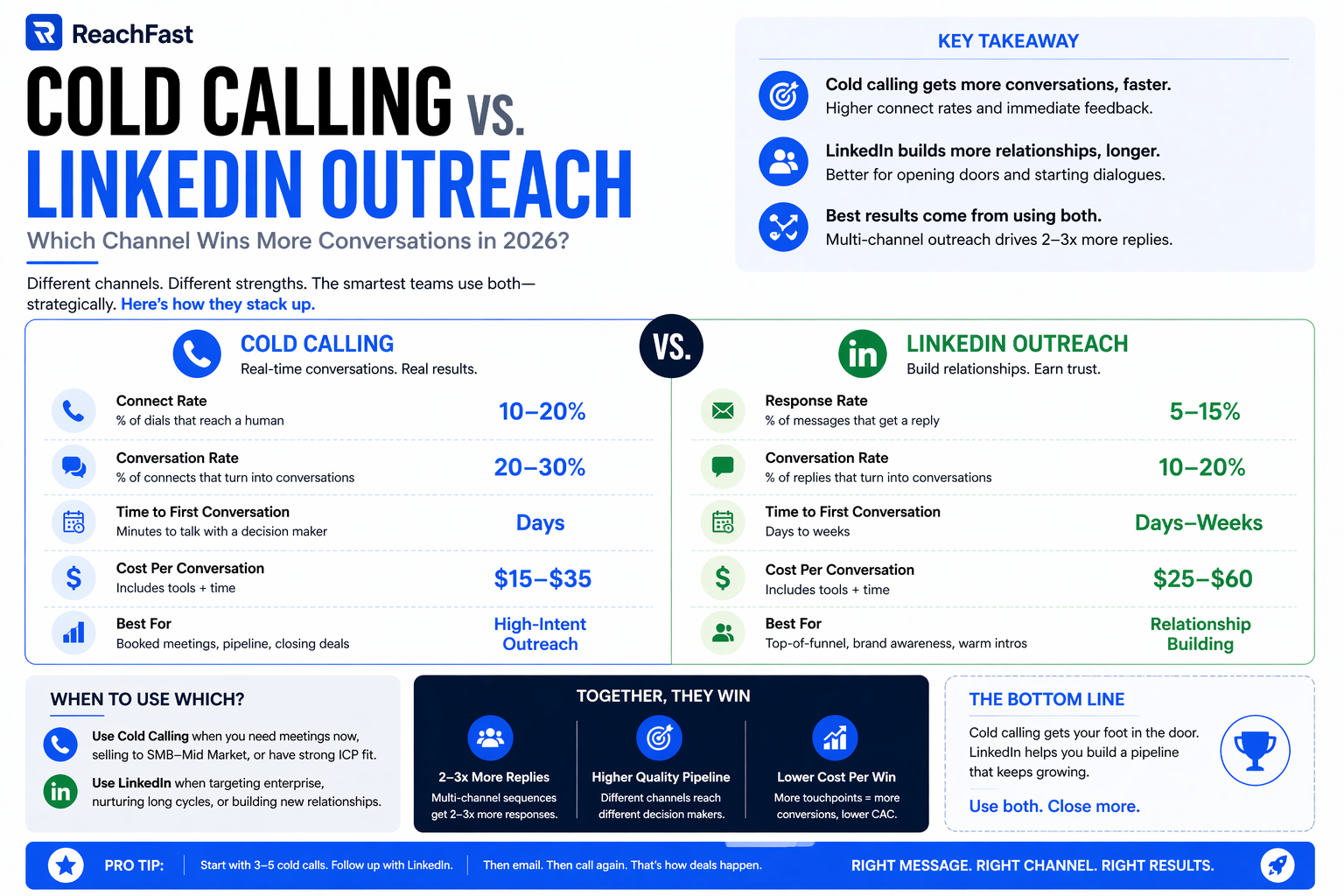
| Metric | Cold email | LinkedIn (InMail/DM) | Cold call |
|---|---|---|---|
| Average reply/connect rate | 1-5% (avg 3.43%) | 9-25% | 8-14% connect rate |
| Meeting conversion rate | 15-30% of replies | 10-25% of replies | 2.5% average, 6.7-15% top |
| Cost per touch | $0-2 (data + infra) | $0 (connect) to $7-10 (InMail) | $0-5 (data + dialer) |
| Time per touch | 30 seconds | 2-3 minutes | 3-5 minutes per live call |
| Best for | High-volume awareness | Warm, visible context | High-intent, high-value |
Key takeaway: Each channel has a sweet spot. However, no single channel beats a coordinated three-channel sequence on any metric that matters.
Myth 1: Cold calling is dead
This myth shows up in every LinkedIn post that ends with “smile and dial is over.” The data tells a different story.
The reality
In fact, 69% of B2B buyers accepted cold calls from new providers in the past year, per Martal’s 2026 outreach research. Plus, nearly half of C-level executives prefer phone outreach once initial interest exists. Meanwhile, 50-60% of B2B buyers still list phone as part of how they want to be contacted.
Why the myth persists
Then why does everyone say cold calling is dead? Because cold calling with stale numbers, no research, and generic scripts really is dead. A dialer pointed at a 6-month-old list hits 30-40% disconnected numbers and 5% live connects. So the channel looks broken when the data is broken.
Meanwhile, cold calling with verified direct dials, signal-based targeting, and a specific opening question routinely hits 10-15% connect rates with 6.7-15% meeting conversion.
What actually works
So the fix isn’t “stop calling.” Rather, it’s “call better.” That means verified direct dials, current data, the 10-11 AM or 4-5 PM local window, and a script that doesn’t sound like a pitch.
Myth 2: LinkedIn is always more personal
Founders and SDRs love LinkedIn because it feels warm. You see the prospect’s photo, their recent post, their mutual connections. However, that warmth doesn’t automatically translate to higher reply rates.
The reality
In contrast, LinkedIn DMs and InMails hit average reply rates of 9-25%. Plus, Expandi’s 2026 analysis of 20 million LinkedIn outreach attempts found personalized connection requests get 9.36% reply rate. Meanwhile, connection requests with no message hit only 5.44%.
So “personal” is doing a lot of work. The warm feel of LinkedIn only shows up in the reply rate when you actually personalize. A generic InMail reads exactly like a generic cold email.
Why phone still wins on some dimensions
Also, phone calls let you hear tone, catch hesitation, and respond to objections in real time. LinkedIn doesn’t give you that. So for discovery or qualification, phone is usually the stronger format even when LinkedIn has higher response rates.
What actually works
However, LinkedIn shines when the goal is visibility before the ask. A connection request, a profile view, and a post engagement before a call or email primes the prospect. Meanwhile, LinkedIn alone as the sole channel caps at modest reply rates.
Myth 3: Email has killed cold calling
Email is cheap, scalable, and async. So some teams conclude calling is obsolete.
The reality
In fact, cold email averages 3.43% reply rate per Instantly’s 2026 benchmark, with top performers hitting 10.7%. That’s strong for a scalable channel. However, email alone books roughly 0.5-2% of recipients into meetings.
Meanwhile, email paired with phone calls lifts response by 128% versus email alone. Plus, omnichannel sequences (email + phone + LinkedIn) lift engagement by 287%.
The channel synergy
So email and phone aren’t rivals. In fact, they amplify each other. A prospect reads an email Monday, then a phone call lands Wednesday, and the caller references the email. The prospect feels “warmed,” and connect rates climb. This is why “cold” calling in 2026 is rarely truly cold. Rather, it’s a phone touch inside a multi-channel sequence.
What actually works
Then, the question isn’t “email or call.” Instead, it’s “when does email lead and when does phone lead?” For high-volume top-of-funnel, email leads. For high-intent or executive outreach, phone leads. Both work together better than either works alone.
Myth 4: LinkedIn outreach is free
LinkedIn feels free because you don’t see a per-message charge. So teams assume LinkedIn is the low-cost channel.
The reality
However, LinkedIn Recruiter Corporate costs $999/month per seat. Sales Navigator runs $99-149/month. Plus, InMail credits on overage run $8-12 each. Meanwhile, connection requests cap at roughly 100 per week per account, which limits how much you can actually send.
So a “free” LinkedIn DM costs your seat license, the credit math, and the 2-3 minutes of SDR time per personalized message. At $100k SDR OTE and 2,000 working hours per year, that’s about $50 per hour. A 3-minute personalized DM costs ~$2.50 in labor alone.
The hidden ceiling
Plus, LinkedIn algorithmic throttling adds another cost. Send too many connection requests in a week and LinkedIn restricts your account. So teams hit a volume ceiling far below what email or phone allow.
What actually works
Meanwhile, cold calling at scale ($0.10-0.20 per dial with a verified list) and cold email ($0.01-0.05 per send) both offer lower per-touch cost at higher volume. So LinkedIn’s real strength is warmth, not cost.
Myth 5: Cold calling only works for enterprise
Some teams believe calling is only effective when the deal size justifies the rep time. Smaller deals supposedly should stay async.
The reality
In contrast, cold calling scales by deal size, not against it. SMB sellers calling SMB prospects hit strong connect rates because smaller companies have fewer gatekeeper layers. Plus, founder-led outbound into SMB and mid-market routinely produces 15-20% connect rates.
Meanwhile, enterprise is where calling gets harder because of assistants, switchboards, and mobile-only CEOs who screen hard.
Where calling wins
However, calling wins for:
- Recovering stalled deals (a phone call re-engages dead pipeline faster than any email)
- Fast qualification (a 5-minute call confirms or kills a deal in one touch)
- High-intent signals (website visit, pricing page view, competitor comparison page)
- Re-engaging former customers or buyers from past roles
So the question isn’t deal size. It’s intent level and channel preference.
What actually works
Then, run calling as part of a multi-channel sequence regardless of deal size. For SMB and mid-market, calling is often the fastest path to a qualified conversation. For enterprise, calling layers on top of LinkedIn warming and strategic email.
The reality: multi-channel beats any single channel
Every benchmark in 2026 points to the same conclusion. Belkins’ 2026 analysis of 16.5M cold emails, 20M+ LinkedIn attempts, and 5M cold calls shows multi-channel sequences outperform single-channel across every metric.
Plus, LinkedIn’s own data confirms it. Reps who combine LinkedIn outreach with phone and email generate 45% more opportunities and are 51% more likely to hit quota than single-channel peers.
So the right question isn’t “cold calling vs LinkedIn.” Rather, it’s “how do I sequence them to compound response?”
Decision framework: when to lead with which channel
Match the lead channel to the situation. Then layer the other two on top.
| Situation | Lead channel | Why |
|---|---|---|
| High volume, top-of-funnel | Scales, cheapest per touch | |
| High-intent signal (pricing page, funding news) | Phone | Speed wins; intent fades fast |
| C-suite or VP target | LinkedIn first, then phone | Warm before you ask |
| Enterprise gatekeeper-heavy account | LinkedIn + phone after EA intro | Layer humans before pitch |
| SMB founder-led outbound | Phone | Fastest path to qualification |
| Stalled deal re-engagement | Phone | Breaks the async silence |
| Executive recruiting | LinkedIn + direct email | Two low-friction channels |
| Global outbound across time zones | Email leads, phone follows | Async first, sync second |
Key takeaway: Channel choice is situational. However, every row above benefits from layering the other two channels as follow-ups over 2-3 weeks.
A practical 7-touch cadence combining cold calling and LinkedIn
Here’s a sequence that uses both channels plus email, tuned for 2026 response patterns.
Day 1: LinkedIn connection request + note
First, send a personalized connection request with a short note referencing something specific (a recent post, a mutual connection, a company event).
Day 2: Cold email
Next, send a brief email (90 words max) referencing the LinkedIn touch. Include one specific reason this prospect might care and one clear ask (15-minute call).
Day 4: Cold call + voicemail
Then, call during the 10-11 AM or 4-5 PM local window. If no answer, leave a 20-second voicemail referencing the email.
Day 5: Follow-up email
After the call, send a short email referencing the voicemail. “Just left you a quick voicemail about [topic]. Happy to send a Loom if easier.”
Day 8: LinkedIn message (if connected)
Meanwhile, if the connection request was accepted, send a short LinkedIn DM with a different angle (a relevant article, a specific observation about their company).
Day 10: Second cold call
Then call again, this time at a different time of day. Leave a shorter voicemail if needed.
Day 12: Break-up email
Finally, send a short break-up email. “I’ll stop reaching out after this, but wanted to leave the door open if [outcome] becomes a priority later.”
Key takeaway: Seven touches across three channels in 12 days. Plus, most replies arrive between Day 4 and Day 10. However, the break-up email on Day 12 often pulls in 10-15% of the total replies on its own.
Frequently asked questions
Is cold calling more effective than LinkedIn in 2026?
Neither wins in isolation. Cold calling averages 8-14% connect rate and 2.5% meeting conversion (6.7-15% with tight targeting). Meanwhile, LinkedIn DMs and InMails hit 9-25% reply rate. However, combined sequences lift engagement by 287% vs single-channel. So the right answer is “both, sequenced together.”
What’s the best opening channel for a cold outreach sequence?
Depends on the prospect. For high-intent signals (funding, pricing page visits), lead with phone because speed matters. For executive targets, lead with LinkedIn to warm the channel. For high-volume top-of-funnel, lead with email because it scales. Plus, always layer the other two channels on top over 2-3 weeks.
Do decision-makers still answer cold calls?
Yes, more often than the LinkedIn posts claim. 69% of B2B buyers accepted cold calls from new providers in 2025, per Martal’s 2026 outreach data. Plus, nearly half of C-level executives prefer phone outreach once initial interest exists. So cold calls land when the data is current and the opener is specific.
Is LinkedIn outreach actually free?
No. Sales Navigator runs $99-149/month per seat. LinkedIn Recruiter Corporate runs $999/month per seat. Plus, InMail credits on overage cost $8-12 each. Meanwhile, SDR labor at $100k OTE works out to ~$50/hour, so a 3-minute personalized DM costs $2.50 in labor alone. LinkedIn’s real advantage is warmth, not cost.
How many touches does it take to book a meeting with a cold prospect?
8-12 touchpoints across multiple channels, per 2026 outreach research. For email-only sequences, 3-4 messages is the sweet spot. Beyond 7 email-only touches, returns drop fast. However, adding phone and LinkedIn touches stretches the viable cadence to 7-10 combined touches with higher reply rates throughout.
Do LinkedIn connection requests work better with or without a message?
With a message, substantially. Expandi’s 2026 analysis of 20 million connection requests found personalized messages hit 9.36% reply rate vs 5.44% for no-message requests. Plus, AI-drafted first messages hit 4.19% vs 2.60% for non-AI. However, follow-up messages perform slightly better without AI, which suggests humans should handle the follow-up.
What’s the best cadence pattern for cold calling vs LinkedIn?
Day 1 LinkedIn connection, Day 2 email, Day 4 cold call + voicemail, Day 5 follow-up email, Day 8 LinkedIn message, Day 10 second call, Day 12 break-up email. Seven touches, three channels, 12 days. Most replies arrive between Day 4 and Day 10.
Should I use the same messaging on phone and LinkedIn?
No. Phone calls should open with a question or a specific observation, not a pitch. Meanwhile, LinkedIn messages should reference something visible on the prospect’s profile. Email can carry a slightly longer value proposition but stay under 125 words. Three different formats, same underlying value story.
Turn every channel into a real conversation
Cold calling vs LinkedIn outreach is the wrong question. The right one is: do I have the data to run both well? A sequence that calls stale numbers, DMs wrong titles, and emails dead addresses fails regardless of strategy.
ReachFast is built to make the data problem invisible. Paste a LinkedIn URL or upload a CSV, and get back verified direct dials and emails in one pass. The platform runs a 7+ source waterfall with real-time verification at export, hitting 97%+ email accuracy and 92%+ direct dial accuracy. Plus, credits refund on their own when data is bad, so your dialer and inbox both stay clean. Month-to-month plans start at $39.99 for 1,000 credits and 100 phone numbers. New accounts get 5 free verified contacts on signup. The platform is GDPR, CCPA, and DSGVO compliant for teams running multi-channel outbound into EU markets.
For SDRs, AEs, BDRs, RevOps teams, agency owners, recruiters, and founders running founder-led sales, that means your multi-channel sequence hits live numbers, real inboxes, and current LinkedIn profiles every time.
Sources
- Salesmotion: Cold Outreach Playbook for B2B Sales 2026
- Martal: B2B Cold Email Statistics 2026
- Martal: Cold Calling vs Warm Calling in 2026
- Sopro: 59 Cold Outreach Statistics and Trends 2026
- Belkins: B2B Cold Outreach Benchmarks 2025
- Belkins + Expandi: LinkedIn Outreach Benchmarks Study
- LeadHaste: Outbound Sales Benchmarks 2026
- Martal: LinkedIn Statistics 2026
- SalesBread: 2026 LinkedIn Outreach Stats
- Cleverly: 25+ Cold Calling Statistics 2026