It’s Monday. You pull your target list from three months ago. Then you start dialing and sending emails. By noon, roughly one in five phone numbers rings dead, half your emails bounce, and the prospect you spent weeks digging into just switched jobs last week. Sound familiar?
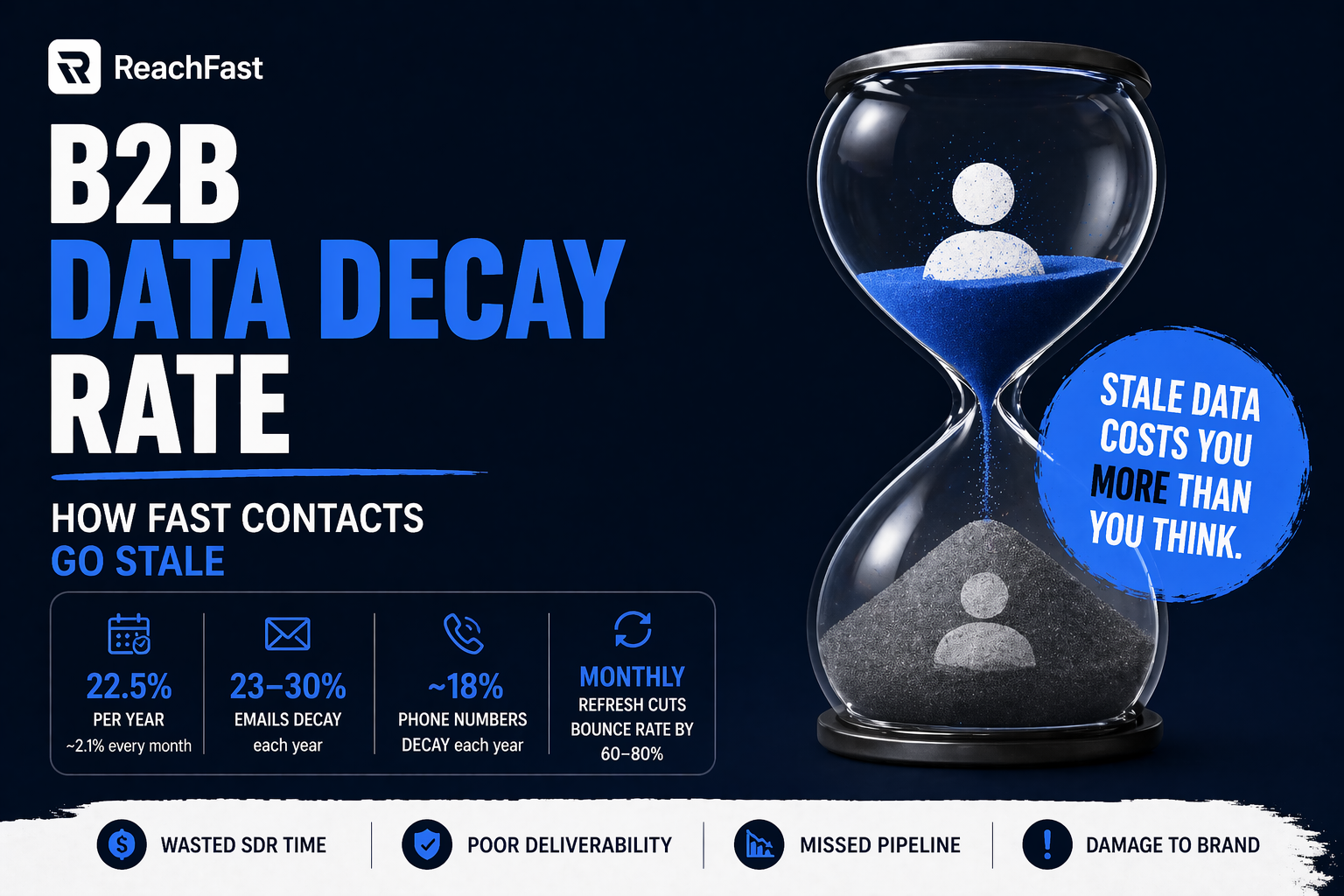
So this is what a B2B data decay rate of 22.5% per year actually feels like on the ground. Sure, you bought good data. But your list quietly rotted on the shelf while you were running other campaigns. Now you’re paying twice: once for the original data, and again in wasted SDR time, a shaky sender reputation, and missed quota.
In this article, you’ll see exactly how fast B2B contact data goes stale, which sectors rot fastest, what it costs every month you ignore it, plus a five-step refresh playbook that keeps your list clean without burning a full FTE on data cleanup.
Quick Take (For the Busy Reader)
- B2B contact data decays at 22.5% per year, roughly 2.1% every month.
- Tech contacts churn 25-35% a year, startups 30-40%, manufacturing 10-15%.
- 70% of CRM data is outdated or wrong, costing sales teams 500 hours a year in lost time.
- Top-tier data providers hit 97%+ accuracy, but the industry average sits closer to 50%.
- A monthly refresh rhythm cuts bounce rate by 60-80% on most outbound programs.
What is data decay and why does it hit B2B contacts so hard?
Data decay is just the slow rot of your contact list as people change jobs, get promoted, switch emails, or leave the workforce. Every month, a chunk of your database quietly goes wrong. You don’t notice until the campaign runs and the bounces start.
In B2B, it hits harder than in consumer data. Why? Because white-collar time-in-role is short, mostly in tech and fast-growing companies. Plus, a single job change usually kills three records at once: the email, the direct dial, and the job title. So the decay piles up faster than the headline numbers suggest.
And once the data is wrong, everything downstream breaks too. Your scoring goes off. Segments drift. Sequences hit the wrong people.
How fast does your contact list actually rot?
Here are the numbers from 2026 benchmarks.
| Metric | Annual decay | Monthly decay |
|---|---|---|
| Overall B2B contact data | ~22.5% | ~2.1% |
| Email addresses | 23-30% | ~2-2.5% |
| Telephone numbers | ~18% | ~1.5% |
| Tech industry contacts | 25-35% | ~2.5-3% |
| Startups | 30-40% | ~3-3.5% |
| Manufacturing | 10-15% | ~1-1.3% |
Key takeaway: A list you verified three months ago is already 6-7% stale. Six months ago? 12-15% stale. A year old? Roughly a quarter of it is dead weight.
The hidden costs most teams don’t track
Most teams watch bounce rate and move on. But stale data burns budget in places no dashboard catches.
Wasted SDR hours
Reps spend 20-30% of their time on non-selling data tasks. For a team of 10 reps at $100K OTE, that’s roughly $250,000 in lost selling time every year. Plus, you paid for the bad data on top of that.
Sender reputation damage
When bounce rates creep above 2-3%, Gmail, Outlook, and Yahoo start pushing more of your future mail to spam. The catch is that recovery takes months, not days. One bad list can quietly kill a domain’s deliverability for a full quarter.
Forecast risk
Bad contact data also skews your forecast. If 15% of your “engaged” contacts are at companies they’ve since left, your pipeline looks too high. So RevOps teams then make territory and quota calls on numbers that aren’t real.
Brand friction
Finally, there’s the brand cost. Sending “Hi Sarah, saw you’re leading growth at Acme” to someone who left Acme eight months ago makes you look lazy. That hit is harder to price, but it’s real.
B2B data decay rate by sector: which areas rot fastest?
Not every sector ages the same way. Here’s what the 2026 data shows.
| Sector | Annual decay | Why it decays fast |
|---|---|---|
| SaaS and tech | 25-35% | Rapid hiring, layoffs, frequent role swaps |
| Startups (all sectors) | 30-40% | Pivots, funding rounds, team resets |
| Financial services | 20-25% | Regulation-driven moves, M&A |
| Professional services | 18-22% | Up-or-out career paths |
| Healthcare | 15-20% | Steady role moves, stable credentials |
| Manufacturing | 10-15% | Long time in role, niche jobs |
| Government and public sector | 8-12% | Stable jobs, long tenure |
Key takeaway: If you sell into tech or startups, you need a refresh rhythm closer to monthly. If you sell into manufacturing or government, quarterly is fine.
The monthly refresh playbook
Here’s a five-step process you can run on the first of every month. For a list of 5,000 contacts, it takes 2-4 hours and cuts bounce rates by 60-80% on most programs.
Step 1: Audit your current list
First, pull your full prospect list and tag every record with its last-verified date. Records over 90 days old go in the “refresh” bucket. Those in the 30-90 day range get a spot-check. Contacts under 30 days can stay.
Besides the date, tag sector. Tech-heavy segments need more care. Also check for clear signs of rot: hard bounces, dead numbers, “no longer at this company” replies.
Step 2: Segment by recency
Next, split the refresh bucket into two groups:
- Stale but still relevant: right ICP, right company, but probably wrong contact.
- Stale and uncertain: unclear if the account still fits your ICP.
Handle these two groups in different ways. The first group gets re-verified. The second gets re-qualified first, then re-verified.
Step 3: Run verification
Then run every email in the refresh bucket through an email verifier. Most verifiers sort emails as valid, invalid, risky, or unknown. Send only to the valid bucket. Drop invalid records or flag them for re-filling.
For phone numbers, verification is trickier. So you’ll need either a provider that does real-time phone checks or a manual sample-call audit on a small sample.
Step 4: Re-fill the stale segment
After verification, re-fill the records flagged invalid. This is where contact data tools earn their keep.
A waterfall-style platform pulls from several sources in sequence, so if the first one misses, the second or third fills in. ReachFast, for instance, runs a 7+ source waterfall with real-time verification at export, hitting 97%+ email accuracy and 92%+ direct dial accuracy. Plus, the automatic credit refund on bad data keeps the monthly refresh budget easy to plan, which matters for RevOps teams reporting to finance and agency owners billing per client.
Step 5: Re-verify at send
Finally, verify once more at the moment you queue the send. People change jobs between Monday morning and Friday afternoon. So a second verification pass catches the last sliver of decay that happened in the past week.
How often should I re-verify my B2B contact list?
The short answer depends on your industry mix. Here’s a simple schedule guide.
| Your ICP | Refresh schedule |
|---|---|
| SaaS, tech, AI startups | Monthly |
| Agencies, media, marketing | Monthly |
| Financial services, insurance | Every 6 weeks |
| Professional services (legal, consulting) | Every 8 weeks |
| Healthcare, pharma | Quarterly |
| Manufacturing, logistics, industrial | Quarterly |
| Government, education | Every 6 months |
Key takeaway: Match schedule to ICP. Monthly for high-mobility sectors, quarterly for stable ones. Set a calendar reminder on day one of each month and treat the refresh like payroll: not optional.
Tools that keep decay from killing your outbound
A few types of tools matter here. Most teams need two: an email verifier and a data refresh platform.
| Tool type | What it does | Best for |
|---|---|---|
| Email verifier (Hunter, NeverBounce, ZeroBounce) | Checks syntax, SMTP, catch-all at reveal | Teams with existing clean lists |
| Waterfall contact platform (ReachFast, Clay, UpLead) | Fills in from many sources with real-time verification | Teams doing monthly or weekly refresh |
| CRM hygiene tool (Insycle, ZoomInfo OperationsOS) | Dedupes and cleans up in-CRM | RevOps managing 50K+ records |
| Job-change alert tool (UserGems, LeadIQ) | Flags when a contact moves companies | Teams tracking champions and former customers |
Key takeaway: Pair a waterfall data tool with a job-change alert tool. The first keeps your current list fresh. The second tells you when someone worth chasing moves to a new company.
Frequently asked questions
How often does B2B contact data become outdated?
Roughly 22.5% of B2B contact data decays per year, or about 2.1% per month. In tech and startups, that jumps to 25-40% per year. In manufacturing and government, it drops to 10-15%. So a typical list is already 6-7% stale after three months, even without any major disruption.
What causes B2B data to decay so fast?
Three main drivers. First, job changes. People move roles every 2-4 years on average. Second, corporate M&A and restructuring shuts down domains, changes email formats, and reassigns phone numbers. Third, role-level churn like promotions and internal moves quietly breaks job titles even when the person stays at the same company.
Can I just re-verify emails without re-filling contacts?
You can, but you’ll only catch half the problem. Re-verification tells you the email is invalid. However, it doesn’t tell you what the new correct email is. Re-filling finds the replacement record. For a full refresh, you need both.
What bounce rate is OK after a refresh?
Under 2% is the working target for most B2B outbound. Above 3% starts hurting your deliverability. After a clean monthly refresh with verification at export, most teams hit 1-1.5% on cold sends. Higher than that points to stale source data or a missing second verification pass.
Do I need to refresh phone numbers as often as emails?
Usually less often. Phone numbers change at roughly 18% a year versus 23-30% for emails. But direct dials go dead faster than main lines. So for cold-calling-heavy workflows, the refresh schedule should still match your email schedule. Otherwise your AEs will waste time on dead numbers.
How does data decay affect AI-powered sales tools?
It piles on. AI sequencers scale whatever data you feed them, so bad data at scale means automated failure at scale. 45% of CRM data isn’t AI-ready, which means most teams rolling out AI on top of stale contact data are just paying to fail faster.
Is it cheaper to refresh monthly or to buy a fresh list every quarter?
Monthly refresh almost always wins on cost per usable contact. Buying a fresh list quarterly means you pay full price for contacts that were partially decayed the day you bought them. Meanwhile, monthly refresh on a month-to-month plan costs less and keeps bounce rates lower across the whole quarter.
What’s the single highest-impact habit to fight data decay?
A monthly calendar block. Set a recurring two-hour window on day one of every month to run the five-step refresh. Nothing beats sticking with it. Plus, pair it with a tool that verifies at export so new data doesn’t join the old data already stale.
Stop paying for yesterday’s list
Data decay is quiet. It doesn’t show up as a line item on your budget. It just eats 1-2% of your pipeline every month until you wake up to a 20% bounce rate and a burned sender domain.
The fix is simple in idea: verify at export, refresh monthly, and get your credits back when data is bad.
ReachFast is built for exactly that rhythm. Every email and direct dial is verified in real time at export from a 7+ source waterfall, so you’re not starting each month with last month’s decay already baked in. Bad data? The credit refunds on its own. Month-to-month pricing starts at $39.99 for 1,000 credits and 100 phone numbers, and new accounts get 5 free verified contacts on signup. Plus the platform is GDPR, CCPA, and DSGVO compliant for teams selling into EU markets.
For SDRs, AEs, BDRs, RevOps teams, agency owners, recruiters, and founders running their own outbound, that means your list stays clean on a schedule that actually fits your calendar.
Sources
- Cleanlist: How Much Does Bad Data Cost
- Landbase: 39 B2B Database Statistics 2026
- RocketReach: B2B Data Accuracy Trends 2026
- RocketReach: How B2B Data Accuracy Impacts Revenue
- IndustrySelect: The High Cost of Bad Contact Data
- ZoomInfo: Poor Data Quality Impact
- Datafortune: Hidden Costs of Poor Data Quality 2026
- Datamatics: Dirty Data Endangers AI Strategy
- Prospeo: Best B2B Databases in 2026
- The Digital Bloom: B2B Email Deliverability Benchmarks 2025