Your SDR dials 100 prospects. Eight pick up. Same list, same script, same rep. Then, the next day, you change only one thing: when the calls go out. This time, 12 pick up. So that’s a 50% lift in connect rate with zero changes to the pitch.
In fact, best cold call times aren’t a matter of taste. Rather, they’re the single most underused lever in B2B sales. Plus, the wrong window can cut your connect rate by two thirds, while the right one can double it. Meanwhile, most reps still dial when it’s easy for them, not when the prospect is likely to answer.
So this guide breaks down the 2026 data from over 300 million B2B calls across Cognism, Gong, Revenue.io, HubSpot, and Prospeo. After that, you’ll see the heatmap by hour and day, the shifts by role and sector, plus a time zone rolling plan and a 5-minute window trick that doubles pickups on its own.
Quick Take (For the Busy Reader)
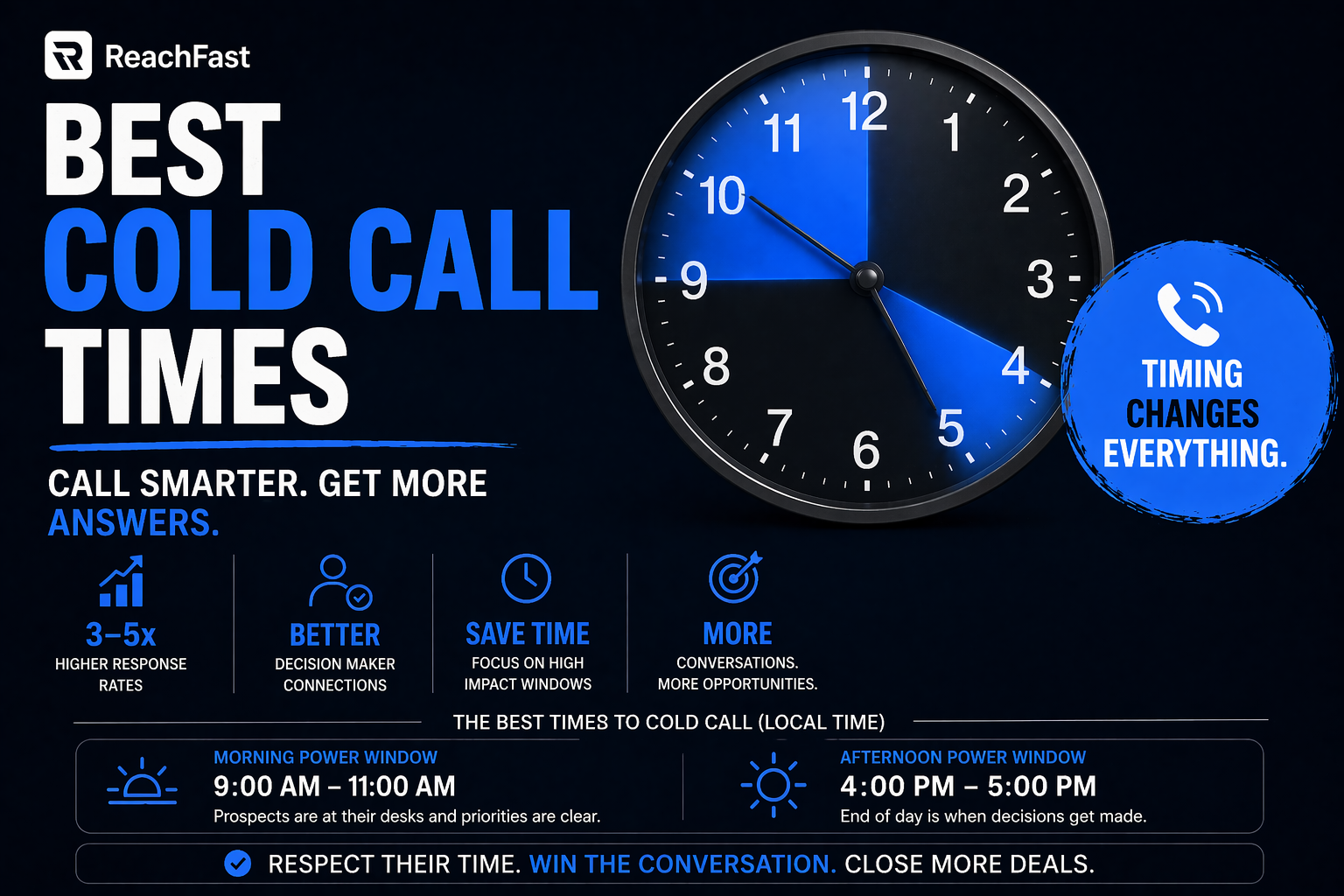
- Tuesday through Thursday, 10-11 AM and 4-5 PM in the prospect’s local time wins on connect rate.
- Thursday 10-11 AM hits 14.2% connect rate versus 4.3% Friday 3-6 PM, per Cognism’s 200K-call dataset.
- Late morning and late afternoon show up as peaks across nearly every major study.
- Lunch hour (12-2 PM) drops answer rates by 28-35%. Honestly, skip it.
- The :25 and :55 “meeting wrap” windows can double pickups on their own.
The headline numbers behind the best cold call times
First, the pattern is consistent across every major study from 2024 through 2026. Though the exact peak hour shifts a bit by dataset, the shape of the day looks the same.
Here’s what the research shows:
- Cognism’s 2026 State of Cold Calling Report, based on 200,000+ B2B calls, ranks Thursday #1 followed by Tuesday and Wednesday. Best hours: 10-11 AM and 2-3 PM.
- Revenue.io, after reviewing millions of dials, found 8-11 AM in the prospect’s local zone lifts connect rates by 15%.
- Prospeo’s synthesis of 300M+ calls shows two daily peaks: late morning and late afternoon, plus mid-week dominance.
- Gong’s analysis of 100,000 connected calls flags both 10-11 AM and 4-5 PM as the top windows.
- CloudTalk found well-timed calls hit 46% higher connect rates than poorly timed ones.
In short, if you run B2B outbound in the US, your calling heatmap shouldn’t look random. Instead, it should cluster tight around two windows per day, three days a week.
The cold call heatmap: day-by-hour connect rates
Below is a composite heatmap based on Cognism, Gong, Revenue.io, and Prospeo data. Green means peak, yellow means workable, red means skip.
| Hour (local) | Mon | Tue | Wed | Thu | Fri |
|---|---|---|---|---|---|
| 8-9 AM | 🟡 Low | 🟡 Medium | 🟡 Medium | 🟡 Medium | 🟡 Low |
| 9-10 AM | 🔴 Skip | 🟡 Medium | 🟡 Medium | 🟡 Medium | 🔴 Skip |
| 10-11 AM | 🟡 Medium | 🟢 Peak | 🟢 Peak | 🟢 Peak | 🟡 Medium |
| 11 AM-12 PM | 🟡 Medium | 🟢 Strong | 🟢 Strong | 🟢 Strong | 🟡 Low |
| 12-1 PM | 🔴 Skip | 🔴 Skip | 🔴 Skip | 🔴 Skip | 🔴 Skip |
| 1-2 PM | 🔴 Skip | 🔴 Skip | 🔴 Skip | 🔴 Skip | 🔴 Skip |
| 2-3 PM | 🟡 Medium | 🟢 Strong | 🟢 Strong | 🟢 Strong | 🟡 Low |
| 3-4 PM | 🟡 Medium | 🟢 Strong | 🟢 Strong | 🟢 Strong | 🟡 Low |
| 4-5 PM | 🟡 Medium | 🟢 Peak | 🟢 Peak | 🟢 Peak | 🔴 Skip |
| 5-6 PM | 🟡 Low | 🟡 Medium | 🟡 Medium | 🟡 Medium | 🔴 Skip |
Key takeaway: The two peak windows are 10-11 AM and 4-5 PM on Tuesday, Wednesday, and Thursday. In total, that’s six hours a week. So if your team runs a focused blitz in those six hours, you’ll beat most teams dialing 40 hours a week at random.
Why do those specific hours work?
First, 10-11 AM hits a sweet spot. By then, morning standups are done, inbox triage winds down, and the prospect has settled in but hasn’t yet hit the first big meeting block. Meanwhile, they’re still mentally fresh.
Then, 4-5 PM lands in the “wind down” window. Slack threads quiet down. Zoom calendars thin out. Decision-makers clear their desks for tomorrow. So they actually have room to take a random call.
On the other hand, 12-2 PM is a cliff. HubSpot found a 35% drop in answer rates during lunch. Plus, Sales Hacker pegs 1-2 PM as the lowest-performing window across every major B2B sector. Simply put, people aren’t at their desks, and the ones who are feel rushed between lunch and the next meeting.
Also, 9-10 AM underperforms because executives sit in standups, sprint planning, or weekend email cleanup. Though it feels like “early bird wins,” the data says otherwise.
Best cold call times by seniority
Generic timing advice breaks down fast when you compare a CEO to a mid-level manager. Here’s how the best cold call times shift by role.
| Role | Best window | Runner-up | Notes |
|---|---|---|---|
| SDRs, managers, directors | 10-11 AM, Tue-Thu | 4-5 PM, Tue-Thu | Standard heatmap applies |
| VPs and senior managers | 8-9 AM, Tue-Thu | 5-6 PM, Tue-Thu | Before/after admin buffer |
| C-suite and founders | 7:30-8:30 AM or 5-6 PM | Friday 2-4 PM | Gatekeepers are gone |
| Technical buyers (CTO, eng leads) | 10-11 AM Tue-Thu | 3-4 PM | Avoid sprint planning slots |
| Finance and ops leaders | 9-10 AM or 3-4 PM | Late morning | Month-end is dead |
| Recruiters (HR, TA) | 10-11 AM or 2-3 PM | Mid-day works | Less meeting-heavy |
Key takeaway: The higher the title, the more you should lean on before-hours and after-hours windows. In fact, roughly 50% of execs are more open to calls on Fridays in the 2-4 PM window, when the gatekeeper has already left for the long weekend.
Best cold call times by sector
Not every industry runs on the same clock. Plus, sector shifts the optimal window by 30-90 minutes.
| Sector | Best time | Why |
|---|---|---|
| SaaS and tech | 10-11 AM, 4-5 PM Tue-Thu | Flexible schedules, async cultures |
| Financial services | 7-9 AM or 4-5 PM | Early market prep, late meeting wind-down |
| Healthcare | 8-9 AM or 3-4 PM | Avoid patient care hours |
| Manufacturing | 7-9 AM | Plant floor starts early; management follows |
| Professional services (legal, consulting) | 10 AM-noon, 3-5 PM | Billable-hour breaks |
| Retail and e-commerce | 10-11 AM Tue-Wed | Mid-week promo planning |
| Government and public sector | 9-11 AM Tue-Thu | Regulated schedules, shorter days |
Key takeaway: Check the prospect’s sector before you dial. For instance, calling a healthcare ops director at 11 AM is almost always a miss, while the same call at 8:15 AM lands at roughly 3x the connect rate.
The time zone rolling strategy
If you’re calling across the US, rolling your dial blocks east to west keeps you in the peak window for every territory. However, most SDRs still dial their whole list at once, then wonder why their West Coast connect rates tank.
The rolling schedule
Here’s how to structure a full day across US time zones.
| Your ET time | Dial | Their local time |
|---|---|---|
| 10-11 AM ET | East Coast prospects | 10-11 AM (peak) |
| 11 AM-12 PM ET | Central prospects | 10-11 AM (peak) |
| 12-1 PM ET | Mountain prospects | 10-11 AM (peak) |
| 1-2 PM ET | Pacific prospects | 10-11 AM (peak) |
| 4-5 PM ET | East Coast prospects | 4-5 PM (peak) |
| 5-6 PM ET | Central prospects | 4-5 PM (peak) |
| 6-7 PM ET | Mountain prospects | 4-5 PM (peak) |
| 7-8 PM ET | Pacific prospects | 4-5 PM (peak) |
Set it up in your dialer
First, tag every prospect with their local time zone. Besides that, most dialers detect this on their own from the area code or from a CRM field. Then, build lists that rotate by zone so you’re always dialing into a peak window.
In contrast, if your dialer doesn’t segment by zone, you burn two of the four daily peak hours on prospects still asleep or already at lunch.
The :25 and :55 window hack
This is the single highest-impact tactic in the whole article. Meetings tend to wrap up five minutes before the hour and half-hour, so :25 and :55 are when people close Zoom tabs and walk back to their desks. In that short window, they’ll answer calls they’d otherwise ignore.
For instance, Prospeo reported an SDR team that tested this for one week. On Monday, sporadic calling got them 17 connects. Then on Tuesday, calling only at :25 and :55 windows delivered 37 connects. That’s a 2x lift from timing alone, with no change in script, list, or rep skill.
So build a 5-minute “pounce” rhythm. Dial at :25, pause at :30, dial at :55, pause at :00. As a result, you’re constantly hitting prospects right when they step back to their phones.
Common cold calling timing mistakes
Most teams make the same few errors. Luckily, each has a quick fix.
Dialing 9 AM sharp
First, 9 AM feels like an early start but it’s really a dead zone. Executives are in standups and sprint planning. So instead, push your morning blitz to 10:15 or 10:30 to dodge both the 9 AM dead zone and the 10 AM competition wave.
Ignoring the prospect’s time zone
Next, calling West Coast prospects at 9 AM ET means reaching them at 6 AM local time. For obvious reasons, that call dies. Plus, it burns a touchpoint you can’t cheaply get back. So always dial by the prospect’s clock, not yours.
Powering through lunch
Then, the 12-2 PM slump isn’t laziness, it’s hard data. Sales Hacker, HubSpot, and Koka all confirm answer rates crater during lunch. Instead, use this block for CRM hygiene, research, email follow-ups, or list prep.
Skipping Friday entirely
However, Friday 2-4 PM is the single best window for C-suite. Gatekeepers are gone. Calendars thin out. Decisions get made. So don’t skip the whole day. Instead, reallocate Friday to exec-only dialing.
Calling stale numbers
Finally, timing means nothing if the number is dead. B2B contact data decays at roughly 22.5% per year, so a 6-month-old list has about 1 in 8 numbers already disconnected. In that case, you’re optimizing against noise.
Frequently asked questions
What is the single best time of day to cold call B2B prospects?
For the US market, 10-11 AM in the prospect’s local time zone, Tuesday through Thursday, wins on average connect rate across Cognism, Gong, and Prospeo datasets. Meanwhile, 4-5 PM is a close second and often wins for senior executives. So if you only have an hour a day to dial, run it at 10:15-11:15 AM local time.
Is Monday really bad for cold calling?
Mostly yes, but not entirely. Monday mornings lag 30-50% behind Thursday on connect rate because prospects are in planning mode, backlogged email, and weekend cleanup. However, MightyCall data shows Monday 8-9 AM hits 26.8% engagement in some studies. So if you have to dial Monday, push it to 2:30-3:30 PM when the early rush clears.
Should I skip Friday cold calls entirely?
Not for executives. In fact, Friday 2-4 PM is one of the best windows for C-suite because gatekeepers are gone and calendars thin out. On the flip side, Friday afternoon for mid-level prospects is the worst block of the week, with roughly 65% of calls going to voicemail. So segment your Friday list to execs only.
How do time zones affect cold calling strategy?
Directly. Calling a Pacific Time prospect at 10 AM Eastern means reaching them at 7 AM their time, when they’re commuting or still waking up. So always dial by the prospect’s local clock. Plus, for a full US territory, roll your dial blocks east to west through the day. As a result, you stay in the peak window for every time zone.
What’s the best day of the week to cold call?
Thursday, based on Cognism’s 2026 analysis of 200,000+ B2B calls. Thursday consistently outperforms Monday and Friday by 30-50% on connect rate. Meanwhile, Tuesday and Wednesday trail Thursday by small margins. Though Wednesday ranks #1 in some EMEA datasets, Thursday wins for US B2B.
How many cold calls does it take to reach a prospect?
On average, 6-8 attempts. Three attempts capture roughly 93% of conversations, and five attempts push that to 98.6%. After five well-timed tries across different days and windows, the return drops near zero. So rotate days and hours between attempts. Otherwise, you’re hitting the same recurring Tuesday meeting every time.
Do cold call connect rates differ by industry?
Yes, quite a bit. For instance, tech buyers respond best to 10-11 AM calls, while healthcare operations leaders are easiest to reach at 8-9 AM before patient care ramps up. Meanwhile, finance professionals often prep for markets at 7-8 AM, so early calls work there. In short, check the sector before you block the time.
How do I know if my own team’s best cold call times match the averages?
Run a 2-week test. First, log every dial with a timestamp and outcome. Then chart connect rates by hour and day. You’ll usually see the same late-morning and late-afternoon peaks, though your specific ICP may shift by 15-30 minutes in either direction. Besides that, track it quarterly as buyer behavior shifts over time.
Stop wasting peak windows on dead numbers
Timing is half the battle. The other half is making sure the number on the screen actually rings a real phone.
B2B contact data decays at roughly 22.5% per year, so a list you bought six months ago has about 1 in 8 numbers already dead. That means your carefully planned 10-11 AM Thursday blitz is burning 12% of its dials on disconnected lines before you even pick up the receiver.
ReachFast fixes that second half. Every direct dial and email gets verified in real time at export from a 7+ source waterfall, hitting 92%+ direct dial accuracy and 97%+ email accuracy. Plus, credits refund on their own when data is bad, so you never pay for a dead dial. Month-to-month plans start at $39.99 for 1,000 credits and 100 phone numbers, and new accounts get 5 free verified contacts on signup. Besides that, ReachFast meets GDPR, CCPA, and DSGVO rules for teams calling into EU markets.
For SDRs, AEs, BDRs, RevOps teams, agency owners, recruiters, and founders running their own outbound, that means your peak windows finally land on phones that ring.
Sources
- Cognism: Best Time to Cold Call
- Revenue.io: Best Time to Cold Call Prospects in 2026
- CloudTalk: Best Time to Cold Call for B2B 2026
- Skipcall: Best Time to Cold Call B2B 2026
- Skipcall: Best Day to Cold Call B2B
- Prospeo: Best Time to Cold Call B2B Prospects 2026
- Salesmotion: Best Time to Cold Call 2026
- ZoomInfo: Best Days to Cold Call
- Convoso: Best Time to Cold Call
- LeadsAtScale: Optimal Cold Call Time Window