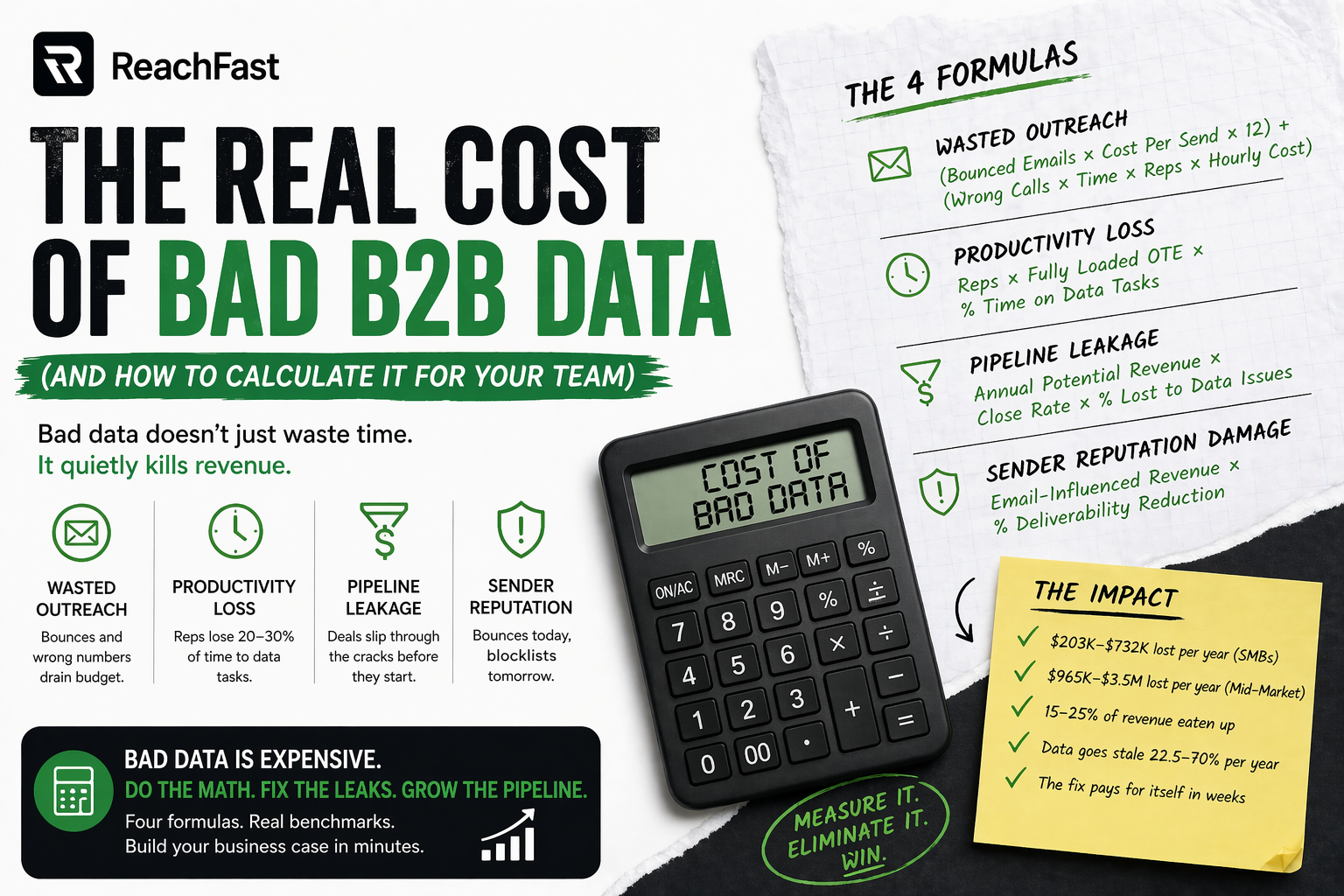
Most teams underfund data quality because they can’t put a number on it.
For instance, you can measure ad spend. Also, you can track rep headcount. Meanwhile, that new tool lands on a line item every month. However, bad B2B data shows up in ways that don’t land on a single line item: bounced emails, dead phone numbers, reps researching instead of selling, pipeline leaking through qualification. By the time anyone adds it up, it’s already cost a quarter of the year.
So this guide gives you the four formulas for working out the cost of bad B2B data for your team, plus benchmarks to compare yourself against and a framework to build the business case for fixing it. No fluff, no generic stats. In short, just the math.
Quick Take: What Bad Data Actually Costs
- SMBs lose $203K to $732K per year to bad data issues
- Mid-market companies lose $965K to $3.5M per year
- Bad data eats 15 to 25 percent of company revenue on average
- B2B contact data goes stale at 22.5 to 70 percent per year
- Sales reps waste 20 to 30 percent of their time on data tasks
- The fix usually pays for itself in weeks
The Four Cost Buckets of Bad B2B Data
Every company loses money to bad data in four ways. Some hurt more than others depending on your setup, but all four add up over time.
| Cost Bucket | What It Covers | Typical Share of Total |
|---|---|---|
| Wasted outreach | Bounced emails, wrong-number calls | 20-30% |
| Productivity loss | Rep time on data tasks instead of selling | 25-40% |
| Pipeline leakage | Deals lost to data issues | 30-45% |
| Sender reputation damage | Deliverability drops from bounces | 10-20% |
Key takeaway: pipeline leakage is almost always the biggest bucket, but it’s the hardest to see. In fact, most teams start with bounces because they’re obvious, then stop there.
Now let’s walk through each formula so you can run your own numbers.
Formula 1: Wasted Outreach
This is the most measurable cost. Specifically, it’s the email bounces, the wrong-number calls, and the rep time spent on touches that never land.
The formula:
Wasted Outreach Cost = (Bounced Emails × Cost Per Send × 12) + (Wrong Calls Per Day × 1.5 min × Reps × 250 days / 60 × Hourly Cost)
Worked example for a 5-rep team:
- 2,000 emails sent per month per rep
- 15% bounce rate = 300 bounced emails per rep per month
- 5 reps × 300 × $0.05 per send × 12 months = $9,000 in wasted email sends
- 10 wrong-number calls per rep per day × 1.5 minutes each
- 5 reps × 10 × 1.5 / 60 × 250 days × $50/hour = $15,625 in wasted call time
- Total Wasted Outreach Cost: $24,625 per year
For most teams, this bucket lands between $20K and $250K per year. Start with this one because the math is clean and nobody can argue with the inputs.
Formula 2: Productivity Loss
Next up, the hidden cost nobody sees until you measure it.
Reps don’t start the day doing outreach. Instead, they begin by researching contacts, cross-referencing tools, cleaning data, and updating records. Sales reps spend 20 to 30 percent of their time on non-selling data tasks, according to Salesforce State of Sales research Cleanlist.
The formula:
Productivity Loss = Reps × Fully Loaded OTE × % Time on Data Tasks
Worked example for a 10-rep team:
- 10 reps × $100K OTE × 25% time on data tasks = $250,000 per year in lost selling capacity
That’s the output of 2.5 reps, gone. And unlike wasted outreach, productivity loss doesn’t shrink when you add more volume. In fact, more volume with bad data makes it worse, because reps spend even more time fixing records.
Common mistake: counting this as “just how reps spend their time.” However, that 25 percent is a fixable line item, not a fact of life.
Formula 3: Pipeline Leakage
This is the bucket most teams never work out. Time to fix that.
Pipeline leakage is what happens when bad data causes deals to die before they start. For example, a wrong title means your message misses the real buyer. A stale role means your outreach hits someone who left the company. Also, a missing trigger event means you call six weeks after the window closed.
The formula:
Pipeline Leakage = Annual Potential Revenue × Close Rate × % Lost to Data Issues
Worked example for a mid-market team:
- $10M annual pipeline
- 30% close rate = $3M in expected revenue
- 10% of potential lost to data issues = $300,000 per year
Ten percent is the conservative estimate. If 10 percent of your potential revenue is lost to data issues, a company with $10M in pipeline and a 30% win rate loses $300,000 Cleanlist. On deeper audits, the real number often lands closer to 15 or 20 percent.
In contrast with Formula 1, pipeline leakage doesn’t show up in your sequencer dashboard. Instead, it shows up as flat pipeline growth and missed quotas, so most teams blame the message or the reps instead of the data.
Formula 4: Sender Reputation Damage
Even if you survive the direct costs, bad data can take out your entire email program.
High bounce rates trigger spam filters. Once your sender score drops, deliverability tanks on every campaign, not just the ones with bad data. On top of that, a single bad send can put your domain on a blocklist, taking out every email for 2 to 4 weeks while you recover.
The formula:
Reputation Cost = Email-Influenced Revenue × % Deliverability Reduction
Worked example:
- $2M annual email-influenced revenue
- 15% deliverability drop from a bad campaign
- 15% × $2M = $300,000 in lost revenue
Meanwhile, recovering a damaged domain takes weeks of clean, low-volume sending. So the cost isn’t just the revenue hit during the damage. On top of that, there’s the ramp time where your team is sending at half speed while the score rebuilds.
The Total Cost Calculator
Here’s where the four formulas combine into one number.
The master formula:
Total Cost of Bad B2B Data = Wasted Outreach + Productivity Loss + Pipeline Leakage + Reputation Damage
Worked example for a 10-rep mid-market team:
| Bucket | Annual Cost |
|---|---|
| Wasted outreach | $24,625 |
| Productivity loss | $250,000 |
| Pipeline leakage | $300,000 |
| Reputation damage | $50,000 |
| Total | $624,625 |
Key takeaway: for this sample team, bad data costs roughly $62K per rep per year. Even cutting the impact in half would pay for an enterprise data contract twice over.
Benchmarks by Company Size
How do your numbers stack up against the averages?
| Company Size | Typical Annual Cost of Bad Data |
|---|---|
| Solo / Small Team (1-5 reps) | $50K – $200K |
| SMB (5-25 reps) | $203K – $732K |
| Mid-Market (25-100 reps) | $965K – $3.5M |
| Enterprise (100+ reps) | $5M+ |
These ranges come from aggregated industry data across Gartner, Experian, and Dun & Bradstreet research. Your specific number depends on deal size, sales cycle length, and how much your revenue depends on outbound.
In general, if your team has never worked this out, you’re probably under the real number by 30 to 50 percent. The wasted-outreach bucket is visible. On the other hand, the other three hide in plain sight.
Why the Problem Gets Worse Every Quarter
Bad B2B data isn’t a one-time fix. Instead, it’s a leak that widens if you ignore it.
For instance, B2B contact data decays 22.5 percent to 70.3 percent each year Instantly. That means a list you built in January is wrong by December without action. In high-turnover industries like tech, the rate hits 70 percent or more per year.
So the true cost of bad data has two parts: the cost of today’s bad records, plus the cost of records going stale between now and your next refresh. Teams that only look at the first part miss roughly half the total.
The Fastest Way to Reduce Cost
Four quick wins that cut bad-data cost fast:
1. Switch to a data source that checks at export. Most databases refresh quarterly or monthly. In contrast, a tool like Reachfast checks every email and phone at the moment you pull it, so stale records never make it into your sequences. For teams running high-volume outbound, this one change cuts wasted-outreach cost by 70 to 90 percent.
2. Run a second-pass check on any imported list. Tools like ZeroBounce or NeverBounce cost a fraction of a cent per address. Add this as a mandatory step before every campaign. As a result, bounce rates drop by 80 percent or more on average.
3. Set up job-change tracking. Tools that alert you when a contact moves companies let you refresh records in real time instead of finding out from a bounce. Also, this kills the “person left the company” bucket before it becomes a cost.
4. Document where each record came from. When you know which source contributed a bounce, you can rank your vendors by real accuracy. In fact, most teams find that one of their paid data sources is producing the majority of their wasted-outreach cost.
How to Build the Business Case for Fixing It
When you take the cost of bad data to leadership, frame it as a break-even calculation.
Here’s the pitch structure:
- Current cost: Use the four formulas above to get your total.
- Fix cost: Real-time data tools typically run $1,200 to $15,000 per year depending on volume.
- Expected recovery: Fixing data quality recovers 50 to 80 percent of the total cost.
- Payback period: Most teams see positive ROI within 4 to 6 weeks.
Worked example pitch:
“Bad data is costing us about $624K per year across wasted outreach, rep productivity, pipeline leakage, and sender score damage. A real-time data tool runs $6K per year. Even at 50 percent recovery, that’s $306K back in pipeline with a payback period under 30 days.”
That’s the framing that gets budget approved in one meeting.
Compliance Is Part of the Cost Too
Bad data also carries compliance risk, which most cost calculators skip. For instance, GDPR fines in Europe can hit 4 percent of annual revenue. Meanwhile, CCPA violations in California run $2,500 to $7,500 per intentional violation. On top of that, TCPA cases in the US climbed 95 percent in 2025 alone, with per-call penalties up to $1,500. Each of these stacks on top of the cost of the underlying data problem. So use data sources that document lawful collection, honor opt-outs the same day, and track where each record came from. After all, skipping compliance is a hidden line item in the bad-data equation.
Frequently Asked Questions
How much does bad B2B data actually cost a company?
Bad B2B data costs companies 15 to 25 percent of revenue on average, according to Harvard Business Review and Gartner research. In real terms, SMBs lose $203K to $732K per year, while mid-market companies lose $965K to $3.5M per year. Your specific cost depends on deal size, sales cycle length, and how much of your revenue depends on outbound.
How do I work out the cost of bad data for my team?
Use four formulas combined. First, work out wasted outreach (bounced emails plus wrong-number call time). Second, multiply your rep count by their OTE by the 20 to 30 percent of time they spend on data tasks. Third, estimate pipeline leakage as 10 to 15 percent of your annual potential revenue. Finally, add sender score damage based on email-influenced revenue and deliverability drop. Sum all four for your total.
Why does bad data decay so fast?
Job changes are the main driver. When someone leaves a company, their email stops working within 30 to 90 days. Meanwhile, people change jobs every 2 to 3 years on average, and high-turnover industries like tech see even faster churn. As a result, B2B contact data decays 22.5 to 70 percent per year, which means a list is meaningfully wrong within months of being built.
What’s the biggest hidden cost of bad B2B data?
Pipeline leakage. Most teams measure bounces and wrong numbers because they’re easy to count, but the bigger cost is deals that die silently when reps contact wrong people, miss triggers, or waste time on stale records. For example, a $10M pipeline at a 30 percent close rate loses $300K per year from just a 10 percent data-driven leak.
How quickly can I fix a bad data problem?
Most teams see real improvement within 2 to 4 weeks. Swapping to a real-time data source cuts wasted outreach almost right away. Meanwhile, adding pre-send email checks drops bounce rates in the first campaign. Full recovery from sender score damage takes 2 to 4 weeks of clean sending. In short, the fix almost always pays for itself inside 8 weeks.
Is bad data worth fixing if my team is small?
Yes. Small teams feel the cost more because every wasted hour is a bigger share of total capacity. For instance, a 5-rep team losing 25 percent of rep time to data tasks is basically running at 3.75 reps worth of output. Fixing data quality brings that full 5 reps back online at the cost of a single tool subscription.
What data quality metrics should I track?
Four numbers cover most of it: bounce rate (target under 2%), connect rate on calls (target 18 to 22 percent on real mobile data), email deliverability (track primary inbox placement), and record freshness (aim to re-check every 30 days). In fact, if any of these drift, the cost of bad data is climbing.
How do I compare data vendors based on cost of bad data?
Don’t compare on sticker price. Instead, compare on cost per valid contact. For example, a $500/year tool with 95 percent accuracy costs less per usable record than a $5,000/year tool with 70 percent accuracy, because you’re paying for the stale records with rep time. Also, always ask for a refund policy on invalid data and for real-world accuracy numbers, not marketing claims.
Sources
- How Much Does Bad Data Cost? A Sales Data ROI Framework — Cleanlist
- B2B Email List Pricing, Costs, and ROI Calculation — Instantly
- Cold Email ROI Calculator — Instantly
- B2B Digital Marketing Benchmarks 2026 — Martal
- Free Marketing ROI Calculator 2026 — Marketing Mary AI
- 13 B2B ROI Calculator Examples — Dock
- B2B Outbound ROI Calculator — PunchB2B
- Agentic AI ROI Calculator for B2B SaaS — ARISE GTM