You’ve got a first name, a last name, and a company. Maybe you pulled it off a podcast. Maybe it’s sitting in a LinkedIn URL, an industry roster, or a trade show badge photo. Either way, you need to find someone’s email, and you need it to land without bouncing.
Trouble is, email patterns shift by company size, industry, and even team. Guess wrong and the email bounces. A few bounces tank your sender reputation, and suddenly every pitch you send lands in spam.
So this guide walks you through six methods to find someone’s email by name and company, ranked from fastest to most accurate. You’ll also see a tool comparison, a verification playbook, and the real pattern data used by companies of different sizes.
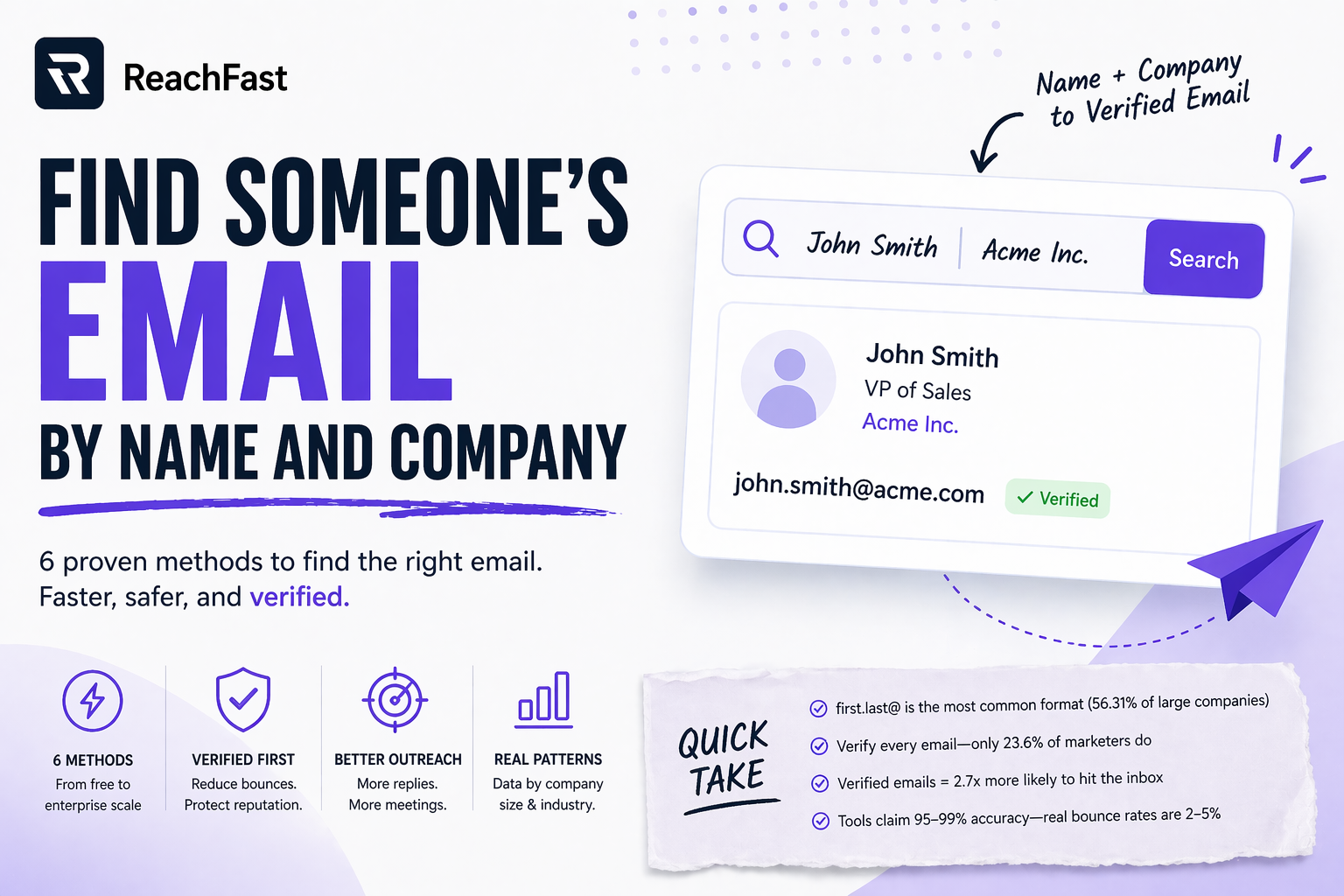
Quick take
- The most common email format globally is first.last@company.com, used by 56.31% of companies with 10,001+ employees, per Interseller’s study of over 5 million companies.
- Top email verification tools claim 95-99% accuracy, but real-world bounce rates still hover at 2-5% on “valid” addresses.
- Only 23.6% of B2B marketers verify email lists before campaigns, per The Digital Bloom’s 2025 deliverability report.
- Fully authenticated domains (SPF, DKIM, DMARC) are 2.7x more likely to hit the inbox than unauthenticated ones.
- The six methods below scale from “one email today” to “CSV of 10,000 LinkedIn URLs.”
Why getting the email right actually matters
Before you chase the address, understand the cost of getting it wrong. Hard bounce rates above 2% can trigger automatic blocklisting with some providers, according to 2026 deliverability studies Derrick App. Recovery takes months, not days.
Plus, Gmail tightened enforcement again in November 2025, meaning non-compliant senders now face temporary or permanent rejection across the three largest inbox providers simultaneously Martal Group. So a guessed-and-unverified address isn’t just a miss. It’s a slow leak on your outbound infrastructure.
Still, the upside is real. Average B2B cold outbound reply rates range from about 3-5.1% Martal Group, and clean-list programs can push well above that. Getting the email right is the cheapest lever you’ve got.
The 6 methods to find someone’s email by name and company
Short version below. Details follow.
Method 1: Guess the pattern, then verify
- Speed: fast
- Accuracy: moderate
- Best for: one-off lookups
Most companies use a predictable format. Data from Interseller’s analysis of over 5 million companies shows that 56.31% of firms with 10,001+ employees use first.last@domain.com, while mid-sized companies of 501-1,000 employees lean toward flast@domain.com at 41.8% Interseller.
So start with the top three patterns:
Then verify each through a free verifier like Hunter, MailTester, or Verifalia. Hunter reports a bounce rate under 1% for emails that pass its verifier Hunter, though no tool is perfect.
Method 2: Use Google search operators
Google dorking takes 60 seconds and costs nothing. Try these queries:
"firstname lastname" + "@company.com""firstname lastname" + email + companysite:company.com "firstname lastname"
If the person has been quoted in a press release, interviewed on a podcast, or listed as a conference speaker, the address sometimes shows up directly. For journalists, founders, and other public-facing roles, this hits more often than you’d expect.
Method 3: Scan the company website
Check the About page, team page, contact page, and any press releases. Startups and smaller firms often list individual emails openly. Some hide them in image files to dodge scrapers, though screenshots read just fine.
Also check the site’s PDF downloads. Whitepapers, press contact sheets, and investor decks frequently list email addresses in headers or footers.
Method 4: LinkedIn profiles and mutual connections
LinkedIn doesn’t usually show emails publicly. However, the “Contact info” section sometimes reveals personal emails for 1st-degree connections. For 2nd and 3rd connections, use the profile to confirm the correct spelling of a name before running a lookup.
Plus, a mutual intro is still the fastest way to land the right address. If you share a 1st-degree connection, a 20-second ask beats any tool.
Method 5: Email finder tools
When you need addresses in bulk or on demand, a dedicated email finder beats manual guessing. These tools run SMTP checks, pattern matching, and cross-referenced databases to return a best-guess address plus a verification score.
Some pull from public web data. Others aggregate from co-op databases and user contributions. Accuracy varies a lot, which is why the next method matters.
Method 6: B2B contact databases with verification at export
For RevOps teams, agency owners, and anyone uploading CSVs of LinkedIn URLs, a waterfall-style contact data platform is usually the cleanest path. These tools pull from 5 to 10+ data sources, then verify each email at the moment of export.
ReachFast, for example, runs a 7+ source waterfall and verifies every email in real time before it lands in your CSV. With 97%+ email accuracy, 92%+ direct dial accuracy, and automatic credit refunds on bad data, you stop paying for bounces. Month-to-month pricing starts at $39.99 for 1,000 credits, and new accounts get 5 free verified contacts on signup.
Which method fits your scenario?
| Your scenario | Best method | Why |
|---|---|---|
| Sending one cold email today | Pattern guess + free verifier | Takes 3 minutes, costs nothing |
| Finding 10-20 prospects for a campaign | Email finder tool | Faster than manual, decent accuracy |
| Enriching a CSV of 500+ LinkedIn URLs | B2B database with verification | Scales, keeps bounce rate under 2% |
| Chasing a journalist, exec, or public figure | Google operators + website scan | Their emails are often listed publicly |
| Tight budget, time to burn | Pattern guess + Google dorking | Free, just labor-heavy |
| Need GDPR/CCPA compliance | Waterfall tool with compliance certs | Ad-hoc methods carry legal risk |
Key takeaway: Match the method to the volume. One email doesn’t need a tool. Five hundred does, and verified data at export protects your domain reputation.
How do email patterns actually break down by company size?
Interseller’s study of 5 million companies revealed clear trends. Smaller teams (under 100 people) often use first@domain.com because they don’t have name collisions yet. As companies grow, they shift to first.last@ or flast@ to handle duplicates.
Here’s the breakdown:
| Company size | Top format | Share |
|---|---|---|
| 501-1,000 employees | flast@domain.com | 41.8% |
| 1,001-5,000 employees | first.last@domain.com | 48.1% |
| 5,001-10,000 employees | first.last@domain.com | 55.23% |
| 10,001+ employees | first.last@domain.com | 56.31% |
Key takeaway: Once a company passes 5,000 employees, first.last is the safest first guess. Below 1,000, try flast first.
Email finder tool comparison
Not every tool fits every workflow. Some lean toward recruiters, others toward outbound sales. Here’s a side-by-side of popular options.
| Tool | Strength | Accuracy claim | Starting price |
|---|---|---|---|
| Hunter | Domain search, browser extension | <1% bounce on valid emails | $34/month |
| Apollo | Large contact database, CRM features | 95%+ claimed | $49/month |
| RocketReach | Covers niche job titles and industries | Varies | ~$80/month |
| Clearout | Pure verification focus | 96-99% claimed | $14 / 3,000 credits |
| ReachFast | LinkedIn URL or CSV input, phone + email | 97%+ email, 92%+ direct dial | $39.99/month |
Key takeaway: If you only need emails, a pure verifier works. If you need phones plus emails from LinkedIn URLs in bulk, pick a tool built for that input format.
The verification playbook (don’t skip this)
Finding the address is only half the job. Verifying it protects your sender reputation.
First, run every address through a verifier before sending. Most tools classify emails into four buckets: valid, invalid, risky, and unknown. Send only to the valid bucket. The risky group includes catch-alls and role-based addresses that can still bounce.
Then authenticate your domain. Only 7.6% of domains currently enforce DMARC, yet fully authenticated domains using DMARC are 2.7 times more likely to reach the recipient’s inbox compared to unauthenticated domains The Digital Bloom. Set up SPF, DKIM, and DMARC before any serious outbound push.
Also, reverify periodically. Email data decays as people switch jobs and mailboxes shut down. A list you verified six months ago is already partially stale, so quarterly cleaning is a safe rhythm for active senders.
Quick-win workflow for SDRs and BDRs
If you’re running outbound daily, here’s a repeatable flow:
- Pull LinkedIn URLs from Sales Navigator or your ICP filter.
- Upload the CSV to a waterfall contact tool.
- Pull emails and direct dials in one pass, verified at export.
- Run a second-pass verification through a standalone verifier if you’re paranoid.
- Authenticate your sending domain (SPF/DKIM/DMARC).
- Send in batches of 50-100 per mailbox per day, not 500.
This flow usually runs about 20 minutes end-to-end for 500 contacts, assuming domain auth is already in place.
Frequently asked questions
Is it legal to find someone’s email address from their name and company? In most regions, yes, as long as you handle the data lawfully afterward. B2B email addresses are generally treated as business contact info, though GDPR (EU), CCPA (California), and similar laws regulate how you store, process, and use them. Tools certified under GDPR, CCPA, and DSGVO matter if you sell into EU markets. Check your own jurisdiction before a large campaign.
What’s the most common email format for B2B companies? First.last@company.com dominates mid-to-large firms, with 48.1% to 56.31% adoption depending on company size, per Interseller’s 5M-company dataset. Below 500 employees, flast and first-only formats show up more often. Small consumer-facing brands sometimes use creative patterns too.
Why do my guessed emails keep bouncing? A few culprits. Many companies run catch-all servers that accept anything at the domain, which confuses verifiers. Others use custom patterns like initials plus a department code that don’t match standard templates. Plus, email data decays steadily as people switch jobs.
How accurate are email verification tools? Top verifiers claim 95-98% accuracy Derrick App, but real-world data shows 2-5% can still bounce due to catch-all traps, recent job changes, or temporary server issues. Use verification as a filter, not a guarantee.
Can I find an email using only a LinkedIn URL? Yes. Tools like ReachFast accept a LinkedIn URL or CSV upload and return verified email and phone data through a multi-source waterfall. Accuracy varies by tool, so check the refund policy before committing to high volume.
What’s the best free method to find someone’s email? Combine Google search operators with a free verifier. Start with "firstname lastname" + "@companydomain.com". If nothing surfaces, guess the top three patterns (first.last, flast, first) and run them through a free verifier. Total cost: zero.
How often should I re-verify my email list? Every 3 to 6 months for active lists. Jobs turn over, mailboxes close, and bounce rates creep up if you don’t clean. High-volume senders pushing 10,000+ emails monthly should verify quarterly at minimum.
Does using an email finder tool hurt my sender reputation? Not directly. What hurts reputation is sending to bad addresses and getting bounces. So any tool that pushes bounce rate below 2% actually protects your domain. The catch is that some tools inflate accuracy claims by counting risky emails as valid, which still leads to bounces. A visible refund policy usually signals real confidence in the data.
Sources
- Interseller: Top Email Address Patterns By Company Size
- Aerosend: Top Email Verification Tools in 2026
- Hunter: Email Verifier
- Clearout: Email Verifier Accuracy
- Martal: B2B Cold Email Statistics 2026
- Verified.email: B2B Email Benchmarks 2025-2030
- The Digital Bloom: B2B Email Deliverability Benchmarks 2025
- SQ Magazine: B2B Email Marketing Statistics 2025
- Derrick App: Bounce Email Checker Guide 2026
- SalesHive: B2B Email Marketing Best Practices 2025