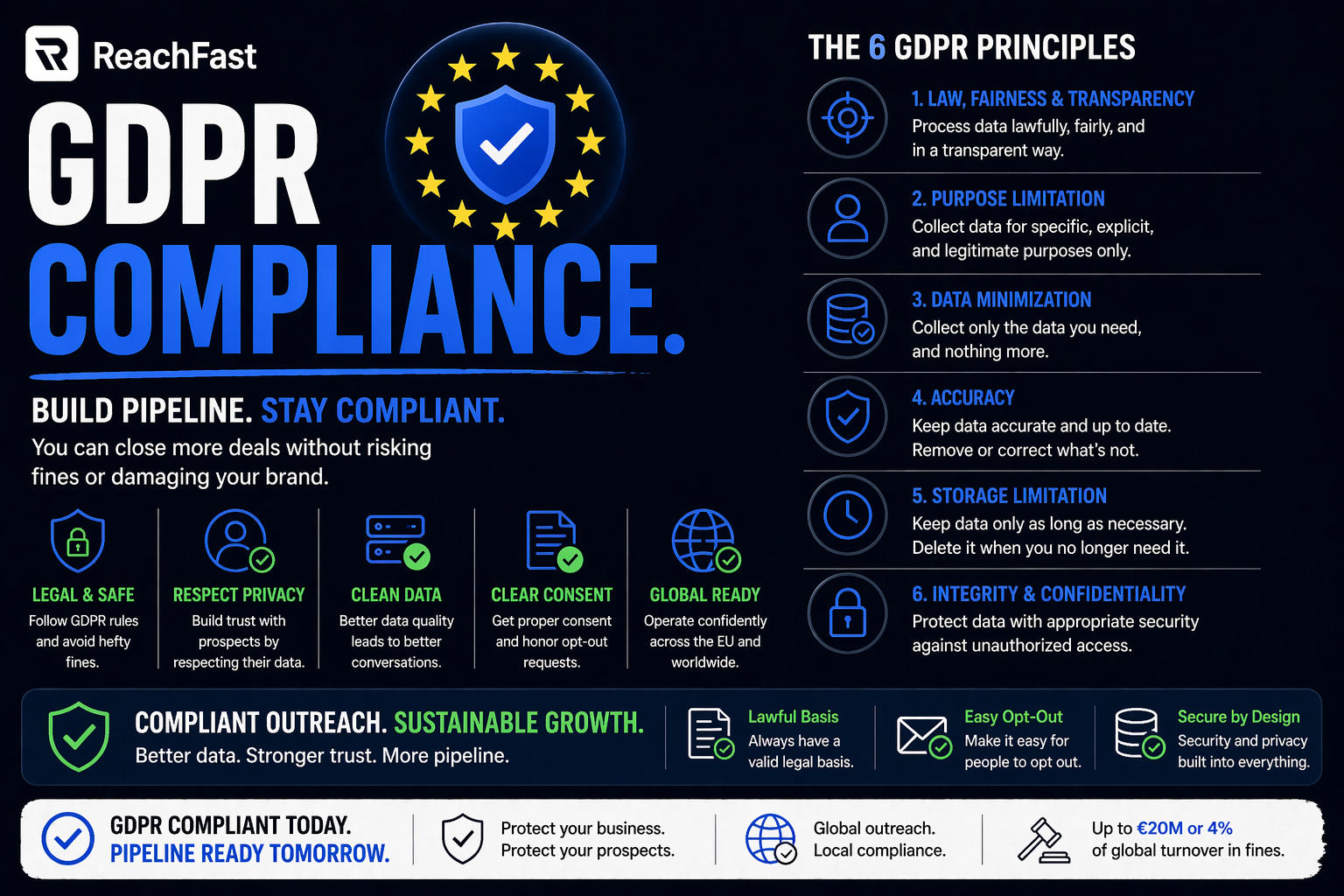
You’re buying a B2B contact list for EU prospecting. The vendor says “GDPR compliant” on the pricing page. However, when you ask for a Data Processing Agreement, they go quiet. Meanwhile, your CMO wants outbound running by next quarter, and your legal team wants proof nothing’s going to trigger a €20M fine.
So here’s the reality: GDPR compliant B2B data isn’t a marketing label. In fact, it’s a specific set of sourcing, retention, documentation, and processing standards. Get them wrong and you inherit your vendor’s liability. As a result, “compliance” often ends up being your problem, not theirs.
This pillar article breaks down what GDPR actually requires for B2B contact data, how the legitimate interest basis really works, which vendor practices matter, and a buyer’s checklist you can take into any procurement call. Plus, we’ll cover UK, Germany (DSGVO), and California (CCPA) overlap so your EU outbound doesn’t surprise you six months in.
Quick Take (For the Busy Reader)
- GDPR fines have reached a cumulative €7.1 billion since 2018 Unify, and European data protection authorities issued over 330 fines in 2025 alone Unify.
- B2B contact data (named work email, direct dial) counts as personal data under GDPR.
- Legitimate interest (Article 6(1)(f)) is the correct legal basis for most B2B outbound, but requires a documented 3-part test.
- Max retention for unused B2B prospect data is typically 3 years.
- California’s B2B exemption expired on January 1, 2023 Persana AI. So CCPA now covers business contact data too.
- Vendor certs to demand: SOC 2 Type II, ISO 27001, ISO 27701, EU-US Data Privacy Framework participation.
What GDPR actually means for B2B contact data
First, a foundation. GDPR protects personal data of EU residents. However, many B2B teams assume “business contacts don’t count.” That assumption is wrong.
Is B2B contact data personal data?
Yes, whenever it identifies a natural person. So named work emails like jane.smith@company.com are personal data. Direct dial mobiles tied to a name are personal data. Meanwhile, generic addresses like info@company.com fall outside GDPR scope.
Plus, per iubenda’s 2026 compliance guide, any data that identifies a person directly or indirectly (including IP addresses and personal phone numbers) is in scope. In fact, the test isn’t whether the data is “business” or “personal” but whether it can identify a human.
The six legal bases under Article 6
Next, GDPR gives you six legal bases for processing personal data. For B2B prospecting, only two matter:
- Consent (Article 6(1)(a)): explicit opt-in.
- Legitimate interest (Article 6(1)(f)): processing when you have a genuine business reason that doesn’t override individual rights.
For B2B cold outreach, legitimate interest is the standard basis. Recital 47 recognizes direct marketing as a legitimate interest FL0, and ICO guidance backs this explicitly. However, legitimate interest isn’t a free pass. Instead, it requires a documented three-part test for every campaign.
The 3-part legitimate interest test
Before you launch any GDPR-covered outbound, run each campaign through this test. Plus, document it in a Legitimate Interest Assessment (LIA).
Purpose test
First, is your reason to contact this person genuine and legitimate? Selling sales automation to a VP of Sales passes. Meanwhile, pitching a gym membership to a CFO at their work email fails, because the offer isn’t relevant to their professional role.
Necessity test
Then, is this processing the least intrusive way to reach the goal? For most B2B outbound, yes. However, if consent already exists through an inbound form, you should lean on consent instead. In contrast, collecting 50 data points when you’ll use 5 violates the data minimization principle.
Balancing test
Finally, does your business interest outweigh the prospect’s privacy interest? For corporate-address outreach on role-relevant topics, usually yes. On the other hand, personal Gmail addresses flip the balance. Steer clear unless you have explicit consent.
Key takeaway: You need a written LIA for each campaign. So keep a template handy in your RevOps folder. Plus, regulators expect you to produce this on request.
What makes a B2B contact data source GDPR compliant
Now the vendor side. A truly GDPR compliant B2B data source clears four bars. Skip any one and your downstream use is exposed.
Source documentation
First, the vendor should tell you where each contact came from. Public sources (LinkedIn, company websites, press releases, industry directories, Companies House, SEC EDGAR) are defensible. Meanwhile, data bought from unknown resellers is not.
In fact, dropcontact’s legal primer notes that buying a contact database and storing it can itself violate GDPR in some EU jurisdictions. So ask the vendor for a source map during due diligence.
Data Processing Agreement (DPA)
Next, a compliant vendor must provide a DPA on request, without delay. The DPA is a contract defining each party’s role (controller vs processor), the lawful basis, retention, and breach notification duties.
For instance, a provider should be able to produce a GDPR-compliant Data Processing Agreement without delay Unify. If the sales team has to “check with legal” for a week, that’s a red flag.
Retention limits
Then, GDPR limits how long you can hold unused prospect data. GDPR allows B2B data enrichment under legitimate interest without prior consent, but requires informing prospects on first contact, offering a simple opt-out, keeping data for a maximum of 3 years, and documenting all processing activities Derrick App. So records untouched for 3 years should get purged.
Meanwhile, compliant vendors often enrich on demand rather than warehousing giant static databases. That model reduces exposure because you’re pulling fresh data each time rather than holding millions of personal records at rest.
Opt-out and Article 21 rights
Finally, every EU prospect has the right to object under Article 21. So your campaigns must include a visible opt-out, and honoring it must be fast. Plus, the vendor must flag and remove opted-out records from their own system so the same data doesn’t come back to you on the next enrichment pass.
Vendor comparison: how major B2B data providers handle GDPR
Here’s a snapshot of how public compliance posture varies across the main providers. Based on publicly stated positions as of 2026.
| Vendor | Public GDPR stance | DPA available? | EU data residency? | Typical legal basis |
|---|---|---|---|---|
| ZoomInfo | GDPR, CCPA, DSGVO coverage stated on Trust Center | Yes | EU region offered to enterprise | Legitimate interest + own LIA required |
| Cognism | GDPR-first architecture; phone-validated EU data | Yes | EU region | Legitimate interest, CTPS screened |
| Apollo | GDPR compliance page; DPA on request | Yes | US default | Legitimate interest |
| Lusha | GDPR, CCPA certified | Yes | US default | Legitimate interest |
| Clay | Meets GDPR via underlying providers | Yes | US default | Varies by source |
| ReachFast | GDPR, CCPA, DSGVO compliant; refund on bad data | Yes | Regional options | Legitimate interest |
Key takeaway: Public compliance posture is your starting filter, not your finish line. Every vendor on this list still needs a DPA in your specific contract and a clear source documentation trail.
Red flags during vendor due diligence
Some patterns show up again and again when a “compliant” vendor isn’t actually compliant. Watch for these.
No DPA available
First, if the DPA isn’t ready to send on request, that alone is disqualifying. A real compliance posture has this document pre-drafted. Meanwhile, stalling here usually means the vendor hasn’t done the underlying work.
Can’t document data sources
Next, ask “where did this contact come from?” If the answer is vague (“proprietary sources,” “data partners”), push harder. Compliant providers can trace each field to a specific public source or opt-in flow.
No opt-out propagation
Then, check what happens when an EU prospect opts out. Does the vendor remove the record from their database? Or do they just stop serving it to you while still selling it to other buyers? The second model keeps you non-compliant by association.
No EU data residency option
Also, for very sensitive EU workloads, data residency matters. Some vendors only store and process in the US. Meanwhile, enterprise EU buyers often require data to stay on EU servers, which narrows the vendor pool.
“CCPA compliant” but silent on GDPR
Finally, some US-focused vendors claim CCPA compliance but dodge GDPR questions. In fact, the two regimes have different requirements. So CCPA compliance alone isn’t enough for EU outbound.
UK, Germany, and France: where the rules diverge
Though GDPR covers the EU as a whole, national rules add layers. Plus, the UK now runs parallel GDPR legislation post-Brexit.
United Kingdom (UK GDPR + PECR)
First, the UK follows UK GDPR, which mirrors EU GDPR closely. However, PECR (Privacy and Electronic Communications Regulations) adds separate rules for electronic marketing. In particular, for B2B email, legitimate interest still works, but you need to screen against the Telephone Preference Service (TPS) and Corporate TPS for calls.
Germany (DSGVO)
Next, Germany’s DSGVO is the domestic application of GDPR, but enforcement tends to be stricter. German data protection authorities (one per state) move fast on complaints. So any vendor selling into Germany should explicitly state DSGVO compliance, not just GDPR.
France (CNIL guidance)
Then, France’s CNIL has published specific guidance on B2B cold email. The rules say the prospect must have a legitimate interest in receiving your message (relevance to their professional role). Meanwhile, France also treats “freelancer” emails more like B2C because the individual and the business are the same person.
How GDPR intersects with CCPA and US state laws
Meanwhile, the US landscape has shifted fast. So if you run outbound in both regions, track both regimes.
California after the B2B exemption
First, the California Consumer Privacy Act now fully protects personal information of business contacts. Business email addresses with names (like janedoe@business.com), phone numbers, and IP addresses that identify individuals now qualify as protected personal data Persana AI. Plus, California residents can file deletion, correction, and right-to-know requests on B2B data.
Penalties
Then, the dollar impact matters. Current CCPA penalties stand at $2,663 per violation and $7,988 per intentional violation Unify. Meanwhile, GDPR caps are higher: up to €20M or 4% of global annual revenue.
Other state laws
Also, twenty US states have comprehensive privacy laws in effect as of 2026 Unify. However, California remains the only state that explicitly covers B2B contact data. Most other state laws exempt business contacts. So your California exposure is usually larger than your Virginia, Colorado, or Texas exposure.
Key takeaway: For EU + California outbound, build one compliance floor that covers both. So a vendor that handles GDPR well usually handles CCPA well too.
The GDPR compliant B2B data buyer’s checklist
Before you sign a contract with any B2B data provider for EU prospecting, walk through these twelve questions.
- Can the vendor produce a DPA within 48 hours?
- Does the DPA cover your lawful basis (controller vs processor)?
- Can the vendor document each data source to a public origin?
- Does the vendor honor Article 21 opt-outs across all customers?
- Is there a retention limit on unused records (ideally 3 years or less)?
- Does the vendor hold SOC 2 Type II?
- Does the vendor hold ISO 27001 and ideally ISO 27701?
- Does the vendor participate in the EU-US Data Privacy Framework?
- Is EU data residency available (if required)?
- Does the vendor explicitly state DSGVO compliance for German data?
- Is the vendor CCPA compliant for California contacts?
- Does the vendor have a documented data breach notification process (72-hour GDPR rule)?
Key takeaway: If the vendor dodges more than two questions, walk. Meanwhile, a vendor that answers all twelve clearly is probably the safer bet even at higher cost.
Frequently asked questions
Is B2B cold email legal under GDPR in 2026?
Yes, under legitimate interest, provided three conditions are met: your message is relevant to the prospect’s professional role, you disclose your data source, and you include a clear opt-out. However, some EU countries (France, Germany) have stricter national rules under ePrivacy. So always check country-specific rules before launching. Plus, document your LIA for each campaign.
What’s the maximum GDPR fine for bad B2B data practices?
€20 million or 4% of global annual turnover, whichever is higher, per iubenda’s 2026 guidance. Meanwhile, recent enforcement examples include Meta (€1.2B), Amazon (€746M), and LinkedIn (€310M). For smaller companies, fines typically scale to revenue but can still hit €50K-€500K.
Do I need consent to cold email B2B prospects in Europe?
Usually no. Legitimate interest covers most B2B cold outbound. However, B2C-style offers (selling personal services to work emails) require consent. Plus, France’s CNIL recommends opt-in for B2B but allows legitimate interest when relevance is clearly established. So the answer varies by country and offer.
What happens if my data vendor isn’t actually GDPR compliant?
You inherit the liability. Under GDPR, you’re the data controller, and the vendor is your processor. So if the vendor sourced data illegally, your downstream use is illegal too. In practice, regulators target the company doing the outreach, not the data reseller. Plus, some EU jurisdictions (under France’s Code pénal) treat reselling stolen data as a separate offense.
How long can I keep B2B prospect data under GDPR?
A maximum of 3 years without interaction, per 2026 guidance from Derrick and other compliance sources. Meanwhile, if a prospect engages (opens, clicks, replies), the clock resets. Unused records beyond 3 years should be purged. Plus, you should periodically clean stale records as part of your database hygiene.
Is scraping LinkedIn for B2B data GDPR compliant?
Technically, GDPR doesn’t ban collecting public data. However, LinkedIn’s Terms of Service prohibit scraping, which is a separate contractual matter. In practice, using a tool that operates from your own Sales Navigator session and respects LinkedIn’s limits sits in a defensible spot. Meanwhile, anonymous mass scraping is high risk on both GDPR and ToS fronts.
Does GDPR apply if I’m a US company selling to EU prospects?
Yes. GDPR applies wherever you process personal data of EU residents, regardless of where your company sits. So a US startup cold-emailing a London-based CMO falls under GDPR. Plus, if you transfer that data back to US servers, you need an adequacy mechanism (typically the EU-US Data Privacy Framework).
What certifications should I require from a GDPR compliant B2B data vendor?
Four baseline certifications. First, SOC 2 Type II for operational security. Second, ISO 27001 for information security management. Third, ISO 27701 for privacy-specific controls. Fourth, EU-US Data Privacy Framework participation if data crosses the Atlantic. Plus, a DPA available on request is non-negotiable. So any vendor missing these shouldn’t handle EU data in 2026.
EU outbound without the legal risk
Compliance isn’t a tax on outbound. Rather, it’s the foundation that keeps pipeline sustainable, because one €20M fine takes out a decade of campaign spend.
ReachFast is built to sit cleanly inside a GDPR compliant workflow. The platform is GDPR, CCPA, and DSGVO compliant. Plus, every email and direct dial is verified in real time at export from a 7+ source waterfall with 97%+ email accuracy and 92%+ direct dial accuracy. Meanwhile, credits refund on their own when data is bad, so you never pay for records that wouldn’t hold up in a compliance audit anyway. Month-to-month plans start at $39.99 for 1,000 credits and 100 phone numbers. Plus, new accounts get 5 free verified contacts on signup.
For RevOps teams running EU outbound, agency owners managing EU-focused client accounts, SDRs and BDRs dialing into Europe, recruiters sourcing EU candidates, and founders expanding across the Atlantic, that means your legal basis, your vendor certs, and your audit trail all line up from day one.
Sources
- Unify: Sales Leader’s Guide to B2B Data Compliance
- Derrick: GDPR & B2B Prospecting Complete Guide 2026
- Persana AI: Compliant B2B Data 2026 Guide
- Prospeo: GDPR Lead Generation 2026
- iubenda: How does GDPR affect B2B
- FL0 Journal: B2B Intent Data Privacy Reference 2026
- Derrick: GDPR & B2B Data Enrichment 2026
- Cleanlist: GDPR Compliance for B2B Sales
- Dropcontact: B2B and GDPR Compliance
- GrowthList: GDPR Cold Email Guide 2026