Most cold callers don’t have a dialing problem. They’ve got a data problem.
You can have the best script in the world, a rep who can handle any objection, and a clean CRM setup. But if the number you just dialed rings an empty desk, a former employee, or a main office gatekeeper, none of that matters. You’re on hold before you even got started.
That’s the real reason connect rates are so bad in 2026, and it’s also why so many teams have given up on the phone altogether. It’s a mistake. Cold calling still works. You just need numbers that actually belong to the person whose name’s on the account.
Below is what actually works for finding accurate direct dial phone numbers for cold calling, based on what real outbound teams are doing right now.
Why “B2B Phone Data” Mostly Lies to You
Before you pick a method or a vendor, understand what you’re up against.
Most large B2B databases were built the same way. Someone scraped LinkedIn, bought a few data sets from broker networks, and stitched them together. The records sit in a warehouse until you search for them. That’s why accuracy numbers look great in the sales deck and fall apart in the wild.
People change jobs. Numbers get ported. Old cell lines get reassigned. The average time to fill a position is 36 to 44 days, but top candidates are only on the market for about 10 days Recruitaisuite, and hiring managers move even faster than that. A “verified” mobile number from six months ago isn’t verified today.
That’s why the phrase you want to keep an eye out for is “real-time verification at export.” Anything less is a gamble.
Method 1: Pull Direct Dials from Public Sources
Free, slow, and sometimes genuinely useful.
Start with the company’s own website. Press releases almost always include a communications contact, and smaller companies sometimes list direct extensions on team pages. SEC filings are gold for publicly traded targets. Conference speaker pages and podcast episode notes often show a personal cell because the host needed it for scheduling.
A few search strings that pull more than you’d expect:
"[Name]" "[Company]" filetype:pdf"[Name]" "mobile" OR "cell" site:[company].com"[Name]" "[Company]" site:sec.gov"[Name]" "speaker" OR "panelist" "2024" OR "2025"
This approach is worth 10 minutes on your top 20 accounts. It’s not worth running on a list of 500.
Method 2: Use LinkedIn as a Signal, Not a Source
LinkedIn is your source of truth for who the person is, where they work now, and what they care about. It’s not a source for their phone number. That part you’ve got to find somewhere else.
What LinkedIn does give you:
- Confirmation that the person’s still at the company this week
- Job title, tenure, and recent posts you can reference on the call
- Mutual connections who might warm-introduce you
- Occasional Contact Info panels with a website or direct email
Pair LinkedIn with a phone lookup tool and you’ve got a workable pipeline. Rely on LinkedIn alone and you’re stuck with InMail, which averages a 10 to 25 percent response rate and is capped by monthly credits Recruitaisuite.
Method 3: Run a Waterfall Across Multiple Data Providers
Here’s the part most people get wrong.
No single data vendor has the best coverage across every region, every industry, and every seniority level. A provider that nails Silicon Valley VPs might miss every manufacturing plant manager in the Midwest. If you’re paying for one source and accepting whatever it gives you, you’re leaving half your list on the table.
Serious outbound teams run a waterfall. You try source A. If the number’s missing or unverified, you try source B. Then C. And so on. The match rate on a six-source waterfall is often double what a single source can do alone.
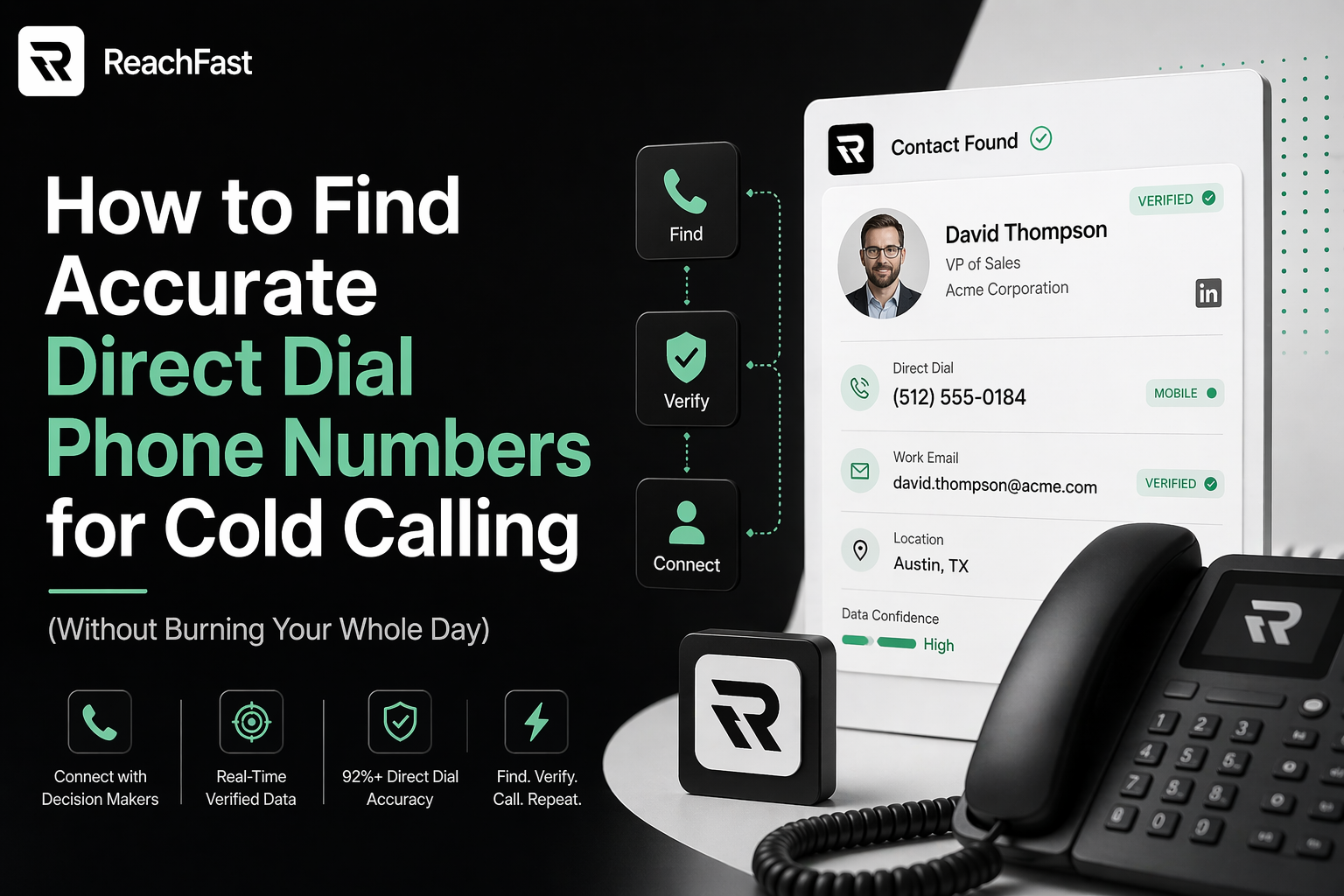
The problem is that running your own waterfall across ZoomInfo, Lusha, Apollo, RocketReach, and three others is expensive, slow, and operationally painful. That’s why tools like Reachfast exist. You paste a LinkedIn URL, and it waterfalls across seven-plus data sources in real time, hands you the best verified mobile number, and charges you only for valid data. If a number turns out to be wrong, your credit comes back automatically. No support ticket, no arguing.
It’s the same approach enterprise data teams use, except you don’t need a RevOps person to build it.
Method 4: Verify Every Number Before You Dial
This is the step most reps skip, and it’s the reason their connect rates look bad.
A number that was valid last quarter might be reassigned this quarter. A mobile number can go disconnected overnight. Verification isn’t a one-time thing at the vendor side. It’s something you should do at the moment of dialing.
Quick checks that take seconds:
- Does the area code match the person’s city? A 212 number for a prospect based in Austin is a yellow flag unless they recently moved from New York.
- Is it actually a mobile line? Run a carrier lookup. If the number comes back as a landline or VoIP number tied to a switchboard, you’re about to call a receptionist.
- Is the number on the DNC registry? For US B2C calling that’s legally required. For B2B it’s still a good signal that the person doesn’t want unsolicited calls.
- Did your vendor verify it at export, not at import? Cached data’s the enemy. If the verification happened three months ago, treat the number as suspect.
Tools that verify at the moment you pull the number, rather than relying on stored records, are the ones worth paying for. Reachfast is built on this principle. Every export runs a fresh check against live data sources, which is how they hold a 97 percent plus email accuracy rate and 92 percent plus direct dial accuracy reachfast claim without getting laughed at.
Method 5: Warm Intros Still Work Better Than Anything
If you can get one, take it every time.
Look at the prospect’s LinkedIn connections. Scan for anyone on your team, anyone in your extended network, or any former colleague who can send a two-sentence intro. A warm intro doesn’t just get you the phone number. It gets the prospect to actually pick up when you call.
Warm intros don’t scale, which is why they get ignored in favor of bulk data pulls. That’s a mistake. For your top 10 accounts per quarter, a warm intro’s worth more than 500 cold dials.
What Good Direct Dial Data Actually Looks Like
When you’re evaluating any vendor, the answer to these questions should be yes:
- Do they verify numbers at the moment of export, not quarterly?
- Do they pull from multiple data sources in a waterfall?
- Do they filter out office numbers and give you mobiles?
- Do they refund you automatically for invalid numbers?
- Are they compliant with GDPR, CCPA, and DSGVO?
- Can they hand you a single-profile lookup, a CSV bulk enrichment, and an API?
If the answer to any of these is no, you’re paying for a worse version of what you could get elsewhere.
31 percent of sales and marketing decision-makers report strong ROI from cold calling Sopro, but that number’s pulled from teams with decent data. Teams running on stale lists don’t see those returns and usually blame the channel instead of the source.
How to Actually Work the Phone Once You’ve Got the Number
The best data in the world doesn’t save a bad call.
Three rules that consistently improve connect-to-meeting conversion:
Call at the right time. Mornings work for most B2B roles, but check the person’s time zone, not yours. Tuesday to Thursday, 9 to 11 a.m. local, is a dependable window. Mondays are meeting-heavy. Fridays are a coin flip.
Lead with a reason. You found this person for a reason. Say it in the first 10 seconds. “I saw you just posted a Senior DevOps role and I’ve got two candidates who placed at similar shops last quarter” beats “Hi, how are you today?” every time.
Ask for 60 seconds, not a meeting. You’re not booking Calendly on the first call. You’re earning the right to send a short email. If you get 60 seconds of real attention, that’s a win.
Top-performing cold callers convert up to 15 percent of conversations into meetings once contact is made Sopro. That’s the number to chase.
The Compliance Part Nobody Wants to Read
Skipping this section’s what gets agencies fined.
In the US, the TCPA restricts automated and prerecorded calls to personal cell phones. The DNC registry applies to B2C and, in some states, B2B. In the EU and UK, GDPR requires a lawful basis for contact and a clear opt-out. Germany layers DSGVO on top. California’s CCPA gives consumers the right to know and delete what you’ve got on them.
What this means practically:
- Use data vendors that source ethically and document compliance
- Honor opt-out requests immediately
- Don’t use automated dialers on personal cells without consent
- Keep a record of where each number came from, so you can prove provenance if audited
Reachfast handles the compliance paperwork on the data side, which is one less thing to worry about when you’re scaling outbound.
The Shortlist
Here’s the whole workflow in six steps:
- Use LinkedIn to confirm the person, the role, and the company
- Check public sources for free direct dials on top-priority accounts
- Run the LinkedIn URL through a waterfall-based phone lookup tool
- Verify every number at dial time, not at export time
- Ask for warm intros on your highest-value targets
- Call at the right time with a specific, non-generic opener
Do this week after week and your connect rate goes from embarrassing to enviable. And you stop blaming the phone.
Frequently Asked Questions
What’s the most accurate way to find direct dial phone numbers for cold calling?
The most accurate method’s running a waterfall across multiple data providers with real-time verification at the moment of export. Single-source databases drift out of date fast because people change jobs every two to three years on average. Tools that pull from six or more sources and verify live, like Reachfast, consistently deliver the highest connect rates. For one-off high-value accounts, public sources like SEC filings, press releases, and warm introductions still work.
How do direct dial numbers differ from office phone numbers?
A direct dial number rings the person’s desk or mobile directly, while an office number routes to a main switchboard or receptionist. Office lines are filtered by gatekeepers who block most unsolicited calls. Direct dials, especially mobile numbers, connect you straight to the decision-maker. For outbound sales and recruiting, direct mobile numbers convert at multiples of what office lines do.
Why’s my cold call connect rate so low?
The most common reason’s bad data. If your list is more than a quarter old, a meaningful percentage of numbers are already wrong. Other factors include calling at the wrong time, dialing office lines instead of mobiles, and skipping carrier verification. Teams that switch to real-time verified mobile data often see connect rates jump from 3 to 5 percent up to 10 to 15 percent with no change in script.
Is it legal to cold call a prospect’s personal mobile number?
In the US, B2B cold calls to mobile numbers are generally permitted as long as you’re not using an automated dialer or prerecorded message without consent, and you honor any do-not-call request. State laws vary. In the EU and UK, you need a lawful basis under GDPR. In Germany you also need to comply with DSGVO. Always use data vendors that source ethically and support opt-outs, and document your compliance.
How much should accurate B2B phone data cost?
Prices vary widely. Legacy enterprise tools often run $15,000 to $30,000 per year with annual contracts and credit traps. Modern real-time tools start under $50 per month for thousands of credits. The better question’s cost per valid contact. A cheap tool with 60 percent accuracy is more expensive than a higher-priced tool with 92 percent accuracy, because you’re paying for bad data with your reps’ time.
Can I verify a phone number before I dial it?
Yes. Run a carrier lookup to confirm the line’s active and identify whether it’s mobile, landline, or VoIP. Cross-check the area code against the prospect’s current city. Use tools that verify numbers at the moment of export rather than relying on stored records. Reachfast runs a triple verification process before numbers reach your export, which reduces your manual verification load significantly.
How many dial attempts does it take to reach a prospect?
Industry averages land between 6 and 8 attempts per decision-maker, but that assumes office-line data. When you’re dialing verified mobile numbers at the right time of day, that number often drops to 2 to 4 attempts. Quality data compresses the entire outbound cycle.
Tired of blaming the phone when the real problem’s the data? Reachfast gives you five free verified decision-maker contacts, no credit card, no sales call. Paste a LinkedIn URL, get a verified mobile number, and see the difference on your next dial.