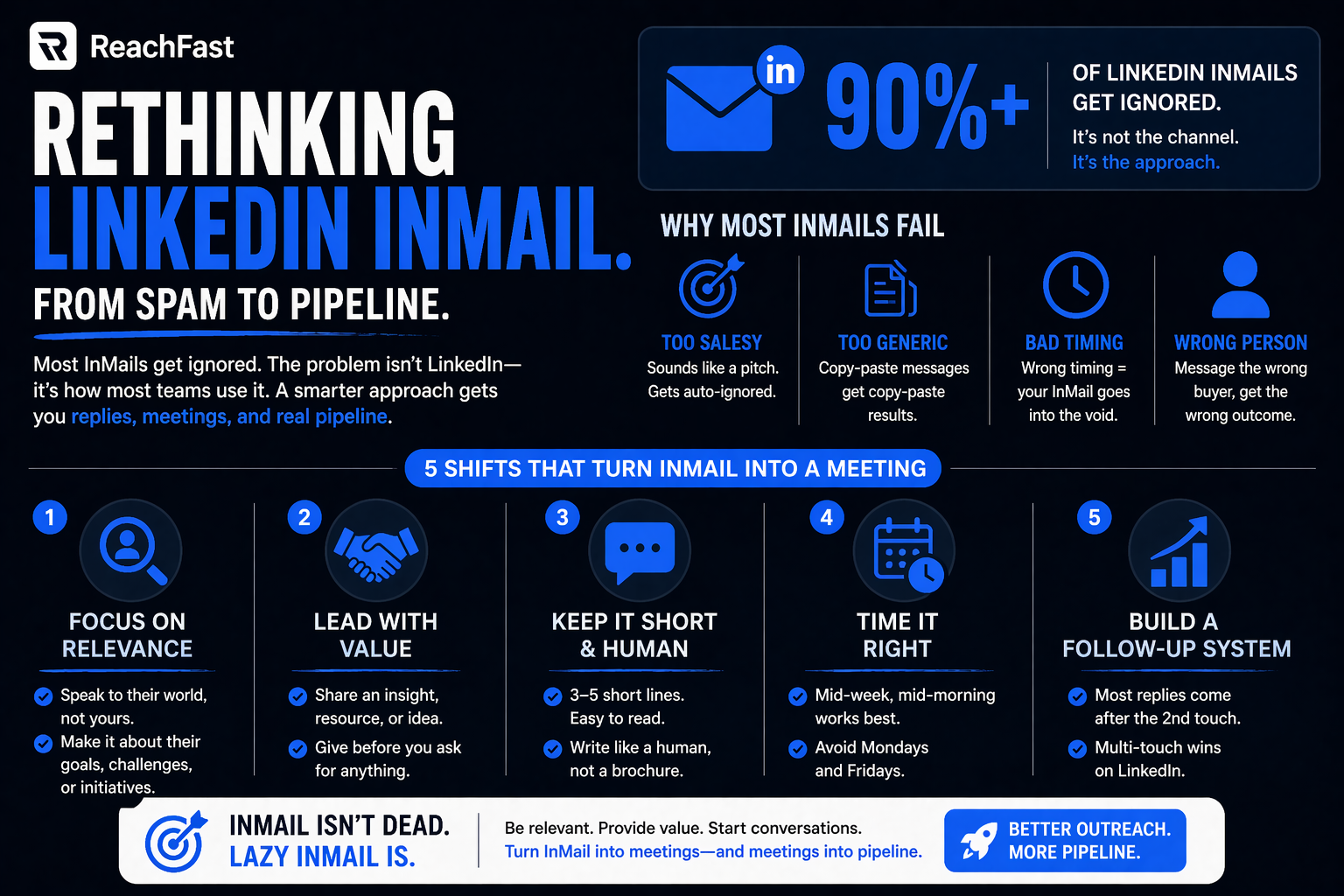
You pay for 150 InMail credits a month. You send 150 messages. Then 135 of them sit unread or ignored. Meanwhile, 15 candidates reply (about 10%), and only 4 or 5 convert to a real conversation. So by the time you’ve booked two phone screens, you’ve burned the full month’s allocation.
This is why it’s worth a moment to rethink LinkedIn InMail as a standalone sourcing channel. Not to abandon it entirely. Rather, to look at what the 2026 data really says about response rates, credit economics, and where recruiters are actually landing their best candidates. Plus, to see what happens when you layer direct email and phone on top of the LinkedIn touch.
This guide walks through the numbers, the hidden cost of “refundable” credits, why response rates have stalled, and a multi-channel recruiter playbook that pushes reply rates past 30-40% in practice. All without ditching LinkedIn as a sourcing layer.
Quick Take (For the Busy Reader)
- LinkedIn’s own data puts average InMail response rates at 18-25%, with talent acquisition specifically around 12% Glozo.
- SaaS and software sees 4.77% response rates, while legal and professional services see 10.42% Sales So.
- Combining InMails with other channels lifts engagement by 287% Sales So.
- LinkedIn penalizes recruiters who fall below a 13% response rate over a 14-day period SeekOut with an “InMail Improvement Period.”
- Multi-channel sequences (email + phone + LinkedIn) can hit 30-48% response in recruiting campaigns.
The data behind the InMail plateau
First, the numbers. In theory, InMail beats cold email. In practice, the gap has narrowed fast.
Average response rates in 2026
LinkedIn’s own benchmark blog reports an 18-25 percent average across all industries, with talent acquisition specifically around 12 percent. Independent studies report a lower range of 3 to 8 percent for cold, templated outreach and 10 to 15 percent for personalized messages. Top performers with tight targeting and 50 to 70 word messages achieve 25 to 40 percent reply rates. Glozo
So the realistic target for most recruiters in 2026 sits in the 12-18% band. Meanwhile, the “elite” 30-40% is rare and usually reflects warm-network outreach rather than cold sourcing.
Industry variation
Response rates also split sharply by sector. Here’s what the 2026 data shows across industries:
| Industry | Response rate |
|---|---|
| Legal and professional services | 10.42% |
| Healthcare | 9.25% |
| Retail and consumer goods | 9.17% |
| Marketing and advertising | 7-9% |
| SaaS and software | 4.77% |
| HR and talent acquisition (recipients) | 12.08% |
Key takeaway: If you recruit in SaaS, your baseline is roughly 5%. So 100 InMails produces 5 replies, and half of those are polite “no.” In contrast, legal and professional services recruiters start from a much higher floor.
The 13% response rate floor
Plus, there’s a hidden penalty. Recruiters must keep their InMail response rate at or above 13% on 100 or more InMail messages sent within a 14-day period. For any subsequent breach of the threshold, you may be placed in an InMail Improvement Period. Fetcher During that period, you can’t send bulk InMails. In fact, this alone pushes many recruiters to hedge with other channels.
Why InMail response rates have stalled
Several forces have pulled response rates down since 2022. Understanding them helps explain why volume alone doesn’t fix the problem.
Inbox fatigue
First, candidates receive far more InMails than they used to. LinkedIn’s platform has grown past 1.2 billion users, and recruiter headcount has grown with it. So the same desirable candidate now sees 5-10 recruiter pitches a week instead of 1-2.
Premium doesn’t mean priority
Next, every InMail competes with sponsored InMails, ads, and connection requests in the same inbox. LinkedIn doesn’t run spam filters inside its messaging system. So the noise piles up fast.
Candidate behavior has shifted
Then, many passive candidates rarely log into LinkedIn. Many passive job seekers do not log into LinkedIn regularly Fetcher, so your message sits unread for days or weeks. Meanwhile, email hits their phone and laptop immediately.
Channel preference data
Also, direct email often beats InMail on preference. According to research done by Stack Overflow, 64% of developers prefer personal emails for recruiting outreach, versus just 4% who prefer being contacted through social media Fetcher. So if you recruit engineers, LinkedIn may actually be the worst channel.
The true economics of InMail credits
Sticker price doesn’t tell the full story. Let’s do the math.
Cost per message vs cost per reply
LinkedIn Recruiter Corporate gives 150 credits per seat per month at roughly $999/month. That’s about $6.66 per credit at list price. However, overage credits run $8-12 each. So the per-message cost sits in the $7-10 range.
Plus, effective cost depends on reply rate. At a 10% reply rate, the effective cost per reply is roughly $70-100. Meanwhile, at 25% reply rate, it drops to $28-40. In short, doubling your reply rate cuts your effective cost per conversation in half.
The refund trap
Then there’s the credit refund policy. LinkedIn refunds one credit for every InMail that gets a reply within 90 days, even a negative one. That sounds generous. However, it only works if your reply rate is already high.
In fact, a recruiter at 10% burns 90% of credits permanently. On the other hand, a recruiter at 30% only burns 70% permanently. So the refund system rewards the top and punishes the middle. Recruiters at 12-15% reply rates (the majority) see modest savings at best.
Rollover caps
Also, unused credits cap at 4x monthly allocation. So Recruiter Corporate’s 150 credits per month tops out at 600 credits total. Beyond that, new credits stop accruing. In contrast, if you pause sourcing for two months, you still lose all credits past the cap.
What’s working for recruiters in 2026
Meanwhile, multi-channel sequences have pulled ahead. Here’s what the 2026 data shows.
Multi-channel beats InMail alone
Combining InMails with other channels increases engagement by 287%, making multichannel sequences far more effective than InMail alone Sales So. In practice, that looks like: LinkedIn touch first, then email, then phone, then LinkedIn again.
Plus, Pin’s automated multi-channel outreach across email, LinkedIn, and SMS achieves a 48% response rate, more than double the 18-25% InMail response rate for recruiting Pin. So the same candidate who ignores a lone InMail often replies when the touch stack includes email or phone.
Direct email + phone vs InMail
Then, email and phone carry weight InMail can’t. First, direct email lands in the candidate’s work or personal inbox where they actually look. Second, a phone call shows serious intent and lets the candidate hear tone. Third, email creates a lasting contact relationship that survives a LinkedIn account change or log-out.
Meanwhile, InMail gives LinkedIn the contact ownership. If a candidate opts out or changes accounts, you lose the touchpoint.
Personal connections beat cold InMail
Also, connection requests get 45% acceptance rate when personalized, and once accepted, follow-up messages have 25-35% response chance vs cold InMail’s 10-25% Sales So. So a personalized connect-and-message sequence often beats a direct InMail, and it’s free.
Channel comparison: InMail vs email vs phone for recruiting
Here’s a side-by-side of the three main recruiter channels in 2026.
| Channel | Typical reply rate | Cost per message | Key advantage | Key limitation |
|---|---|---|---|---|
| LinkedIn InMail (Recruiter Corporate) | 12-25% | ~$7-10 | In-platform, visible to LinkedIn network | Inbox fatigue, 13% floor penalty |
| Direct email (verified) | 5-15% cold, 20-40% warm | $0-2 (data cost) | Lands on phone + laptop, owned channel | Requires verified address |
| Direct phone (mobile) | 15-30% connect rate | $0-5 (data cost) | Human voice, fast qualification | Higher friction per contact |
| Multi-channel (all three) | 30-48% | Blended ~$5-8 | 287% lift over InMail alone | Requires data + coordination |
Key takeaway: No single channel wins outright. However, multi-channel blends consistently outperform any one channel in isolation. Plus, owning the direct email and phone removes your dependence on LinkedIn’s rules.
A multi-channel recruiter playbook
Here’s a practical six-step sequence that integrates InMail rather than replacing it.
Step 1: Source the shortlist
First, build your candidate shortlist in LinkedIn Recruiter or Sales Navigator. Filter by title, skills, tenure, location, and open-to-work signal.
Step 2: Enrich for direct contact
Next, pull direct email and phone for each shortlist candidate. Tools with LinkedIn URL or CSV input return both in one pass. Waterfall platforms hit 80%+ match rates on senior candidates. ReachFast, for instance, pulls verified emails and direct dials from a 7+ source waterfall with real-time verification at export.
Step 3: Day 1: LinkedIn touch
Then, send a personalized connection request or short InMail on Day 1. Keep it under 400 characters. Messages under 400 characters perform 22% better than longer messages Recruitaisuite.
Step 4: Day 3: Direct email
After the LinkedIn touch, send a direct email on Day 3. Reference the role, include one specific reason this candidate stands out, and propose a 15-minute call. Email arrives while the LinkedIn touch is still fresh in their mind.
Step 5: Day 5: Phone call
Meanwhile, call on Day 5. Aim for the 10-11 AM or 4-5 PM local window. Leave a short voicemail if they don’t answer, then text a brief message if you have their mobile.
Step 6: Day 8: LinkedIn follow-up
Finally, follow up on LinkedIn with a short “bumping this up” message on Day 8. At this point, three-quarters of candidates who will reply have already replied through one of the earlier channels.
Common objections to rethinking InMail
Several pushbacks come up when teams shift from InMail-only to multi-channel. Here’s how to think through each.
“InMail has the highest visibility”
First, InMail’s open rate is high (around 57.5%). However, open doesn’t equal reply. Plus, direct email now offers deliverability of 90%+ when you verify addresses at send. So visibility has evened out.
“We already paid for InMail credits”
Next, sunk cost doesn’t change future strategy. Use the credits you have, but measure whether each touch is pulling its weight. Meanwhile, layering email and phone on top often reduces the credits you need next year.
“LinkedIn is where our candidates are”
Then, LinkedIn is where you find them. However, that’s not the same as where they respond. Finding is a sourcing problem. Responding is a channel problem. Plus, most candidates maintain direct email and phone lines outside LinkedIn.
“Email lands in spam”
Also, spam deliverability depends on sender reputation, domain authentication (SPF/DKIM/DMARC), and verified recipient addresses. In fact, a properly authenticated domain sending verified emails hits inbox 90%+ of the time.
“We don’t have candidate emails”
Finally, this is the one real constraint. However, it’s solvable with a contact data tool that accepts LinkedIn URLs and returns verified work or personal emails. Once you have the emails, the multi-channel flow opens up.
Frequently asked questions
What is the average LinkedIn InMail response rate in 2026?
LinkedIn’s official benchmark is 18-25% across all industries. Meanwhile, talent acquisition specifically runs closer to 12%. Independent studies split it into three bands: 3-8% for cold templated outreach, 10-15% for personalized messages, and 25-40% for elite targeted work. So for most recruiters, a realistic target is 12-18% depending on industry and targeting.
Why are my InMail response rates dropping?
Two structural causes. First, inbox fatigue has grown as LinkedIn’s user base passed 1.2 billion and recruiter volume grew with it. Second, many passive candidates rarely log into LinkedIn, so messages sit unread for days. Plus, candidate preference has shifted toward direct email, especially in tech roles where 64% of developers prefer personal email per Stack Overflow research.
Should I stop using InMail entirely?
No. However, treating InMail as your only channel usually leaves 20-30% of potential replies on the table. Meanwhile, the best-performing recruiter teams in 2026 run multi-channel sequences that include InMail plus direct email and phone. So the question isn’t whether to use InMail but whether to add direct channels on top of it.
What’s the 13% InMail floor and why does it matter?
LinkedIn penalizes recruiters whose response rate falls below 13% on 100+ InMails sent within a 14-day period. The penalty is an “InMail Improvement Period” where you can’t send bulk InMails. So recruiters in high-volume, low-response industries (like SaaS at 4.77%) hit this floor often. That’s a strong reason to diversify channels.
How do I get direct emails and phone numbers for LinkedIn candidates?
A contact data tool with LinkedIn URL or CSV input returns verified email and direct dial for each candidate. Waterfall-style platforms (querying 7-20+ data sources in sequence) hit 80%+ match rates on senior candidates. In contrast, single-source tools cap around 40-60%. Plus, real-time verification at export keeps bounce rates under 2%.
Does multi-channel outreach really lift response rates?
Yes, substantially. LinkedIn’s own data and independent studies consistently show 287% engagement lift for multi-channel sequences over InMail alone. Plus, platforms running coordinated LinkedIn + email + SMS report 48% response rates versus 18-25% for InMail-only. So the lift compounds when channels reinforce each other.
Are direct email recruiting campaigns GDPR compliant?
For EU candidates, yes under legitimate interest, provided the role is relevant to the candidate’s profession, you include a clear opt-out, and you document your Legitimate Interest Assessment. Plus, the data source matters. Tools certified for GDPR, CCPA, and DSGVO handle the compliance chain cleanly. Meanwhile, scraped lists without source documentation carry real legal risk.
What’s the best channel for tech and engineering recruiting?
Direct email, based on Stack Overflow’s research showing 64% of developers prefer personal email vs 4% for social media. However, combining email with a warm LinkedIn touch (connection request first, not cold InMail) works better than email alone. Plus, GitHub direct messages and Discord often outperform LinkedIn for senior engineering roles.
The direct-channel recruiter stack
Relying only on InMail caps your response rate at what LinkedIn allows. So adding direct email and phone on top multiplies what you get from the same candidate list.
ReachFast is built for exactly this layer. Upload a CSV of LinkedIn URLs or paste individual profile links, and get back verified work emails and direct dial mobiles in one pass. The platform runs a 7+ source waterfall with real-time verification at export, hitting 97%+ email accuracy and 92%+ direct dial accuracy. Meanwhile, credits refund on their own when data is bad, so recruiters never pay for dead contacts. Month-to-month plans start at $39.99 for 1,000 credits and 100 phone numbers. Plus, new accounts get 5 free verified contacts on signup. The platform meets GDPR, CCPA, and DSGVO rules for recruiting in EU markets.
For talent teams, agency recruiters, RPO firms, executive search, and founders hiring directly, that means your LinkedIn sourcing feeds a multi-channel cadence instead of getting stuck inside LinkedIn’s inbox.
Sources
- Recruit AI Suite: 35 LinkedIn Recruiting Statistics 2026
- SalesSo: LinkedIn InMail Statistics 2026
- GLOZO: LinkedIn InMail Cost and Response Rate Math 2026
- SalesSo: LinkedIn InMail Response Rate Statistics 2026
- LinkedIn Help: InMail Response Rate
- AeroLeads: LinkedIn Recruiter vs Recruiter Lite Pricing 2026
- LinkedIn Talent Blog: InMail Response Rates by Industry and Function
- Pin: How to Recruit Passive Candidates Without InMail 2026
- Fetcher: Why Passive Candidates Prefer Email to InMail
- SeekOut: 7 Alternatives to LinkedIn InMail