There’s a clean answer to the ZoomInfo vs Apollo vs Lusha question, and it’s not the one any of those three companies want you to hear.
The short version: all three are solid. None of them are great. And most sales teams end up paying for two or three at once because no single tool covers everything they need. The average B2B sales team uses 2.7 data providers at the same time, up from 1.3 in 2022, signaling widespread dissatisfaction with single-source accuracy Cleanlist.
This guide breaks down where each tool actually wins, where each one falls apart, and how to pick the right one (or three) for your team without the marketing gloss.
Quick Verdict (If You Only Read This Section)
- ZoomInfo: Best for enterprise teams with $15K+ annual data budgets. Deep North American coverage, strong intent data, weak in Europe, locked into annual contracts.
- Apollo: Best for startups and small teams that want data plus sequences in one login. Affordable, flexible, but real-world accuracy lands around 65 to 80 percent.
- Lusha: Best for individual reps and recruiters doing LinkedIn prospecting. Simple Chrome extension, fast onboarding, pricing scales fast past the free tier.
- The one everyone forgets: Specialized tools that verify at export and refund invalid data. These often outperform all three on phone number accuracy and cost per valid contact.
Now the detailed breakdown.
How Each Tool Positions Itself (and What It Actually Is)
Before the features, it helps to understand what each tool was built to do.
ZoomInfo started as a massive B2B database with strong enterprise sales motion. Over time, it added intent data, conversation intelligence (Chorus), and CRM enrichment. Today, it’s a platform you buy when you have budget and you need the works.
Apollo took a different path. It bundled a contact database with a sequencer, dialer, and Chrome extension, then priced it aggressively. The pitch: all-in-one outbound for a tenth of what ZoomInfo costs.
Lusha stayed simple on purpose. The product is basically a Chrome extension that shows you a prospect’s phone number and email when you hover over their LinkedIn profile. Small team, fast to learn, cheap to start.
Three very different products. So, the comparison isn’t just “which tool is best.” It’s “which one fits your motion.”
Data Accuracy: Where Marketing Claims Meet Reality
Every B2B data tool claims 95 percent accuracy. Real users report something different.
ZoomInfo
The marketing line: 95 percent plus verified accuracy with continuous refresh.
The reality: ZoomInfo’s accuracy holds up well in North America, especially for mid-market and enterprise contacts. Outside the US, results drop off. Users report that accuracy can vary by industry and region. For example, some users found ZoomInfo’s coverage weaker in European markets, leading them to supplement with region-specific providers like Cognism for better EU data Fundraise Insider.
The bigger catch nobody talks about: ZoomInfo uses periodic batch verification, refreshing records on a schedule rather than verifying each email at the time of export. This means the email you export may have been verified days or weeks ago Cleanlist. So the 95 percent number is based on when they last checked, not when you actually use the data.
Apollo
The marketing line: comprehensive global database with solid accuracy.
The reality: real-world numbers land way below the marketing. User experiences with Apollo’s data accuracy cluster around the 65 to 80 percent range. A business development manager shared that the data in Apollo seems to be 75 to 80 percent accurate. Another user reported approximately 65 percent accuracy, meaning roughly one-third of contacts had issues Fundraise Insider.
Phone numbers are the bigger problem. Phone numbers from Apollo were correct roughly 75 percent of the time per one G2 reviewer, while another estimated only 30 to 40 percent of Apollo-provided phone numbers were valid in his region with approximately 50 percent email accuracy Fundraise Insider.
The pattern is clear: Apollo’s accuracy depends heavily on your region and vertical. It works for some teams and fails for others, often in the same quarter.
Lusha
The marketing line: verified phone and email data, GDPR compliant.
The reality: Lusha’s data is solid for US direct dials, especially for mid-level managers. Lusha made a name with their Chrome extension, and their data quality for US direct dials is solid. The free tier is slim at 5 credits per month, and pricing scales quickly once you need volume MillionPhones.
Where it breaks down: bulk enrichment and non-US markets. Lusha is built for hover-and-click, not for enriching a 5,000-row CSV.
Accuracy scorecard
| Tool | Email Accuracy (Real-World) | Phone Accuracy | Best Region | Verification Method |
|---|---|---|---|---|
| ZoomInfo | 85-95% | 80-90% (US), lower elsewhere | North America | Batch refresh |
| Apollo | 65-80% | 30-75% (region-dependent) | Global but inconsistent | Batch refresh |
| Lusha | 75-85% | 80%+ (US mobiles) | North America | Partial real-time |
Key takeaway: if phone number accuracy matters more than email accuracy for your motion, ZoomInfo and Lusha beat Apollo handily. If you’re running email-heavy outbound on a budget, Apollo’s gaps might be acceptable.
Pricing: The Part Everyone Googles First
The pricing gap between these three tools is wider than the feature gap.
ZoomInfo
Enterprise-only. Budget north of $10,000 per year ColdEmailKit, with most team contracts landing between $15,000 and $40,000 annually. Annual commitment required. No month-to-month option. You’ll go through a sales cycle, a procurement review, and at least one quarterly business review.
Translation: if you don’t have a RevOps team and a real budget, you won’t even get a quote you like.
Apollo
Per-user monthly pricing starting around $49 and climbing. Pricing sits at $59 to $149 per user per month with a free tier Cleanlist. The free tier is real and usable. Month-to-month available. No annual lock-in required.
The catch: Per-seat pricing looks cheap until your team grows. A 10-person team pays $12,000 to $18,000 per year, approaching ZoomInfo territory without ZoomInfo’s data depth or intent signals Cleanlist.
Lusha
Free tier (5 credits per month, basically a trial). Paid plans start around $29 per user per month for 480 credits annually, scaling up with volume. No annual contract required on lower tiers.
Cheapest of the three for individual reps. Not cheap at scale for a team of 10 or 20 reps running high-volume prospecting.
Pricing scorecard
| Tool | Entry Pricing | Typical Team Cost (10 reps) | Contract Type |
|---|---|---|---|
| ZoomInfo | $15,000/year minimum | $25,000-$40,000/year | Annual, locked |
| Apollo | $49/user/month | $12,000-$18,000/year | Monthly or annual |
| Lusha | Free tier, then $29/user | $8,000-$15,000/year | Monthly or annual |
Phone Numbers: Where This Comparison Really Matters
If you’re cold calling, phone data is the whole game. So, how do the three stack up?
ZoomInfo has the deepest US phone coverage of the three, particularly for mid-market and enterprise contacts. Direct dial accuracy holds around 80 to 90 percent in the US. European direct dials are thinner. Mobile numbers vary by role seniority.
Apollo is a weak spot here. Phone number coverage exists but it’s thinner than dedicated phone data providers. The platform tries to do everything, which means the data layer isn’t as deep as specialists MillionPhones.
Lusha focuses heavily on mobile numbers, especially for SDRs and AEs prospecting on LinkedIn. US mobile accuracy is strong. International coverage weakens as you leave North America.
One important note on all three: a “direct dial” in their databases often means a desk phone extension, not a personal mobile. Since remote work took over, desk phones ring empty rooms. If you want to reach someone today, you want their cell.
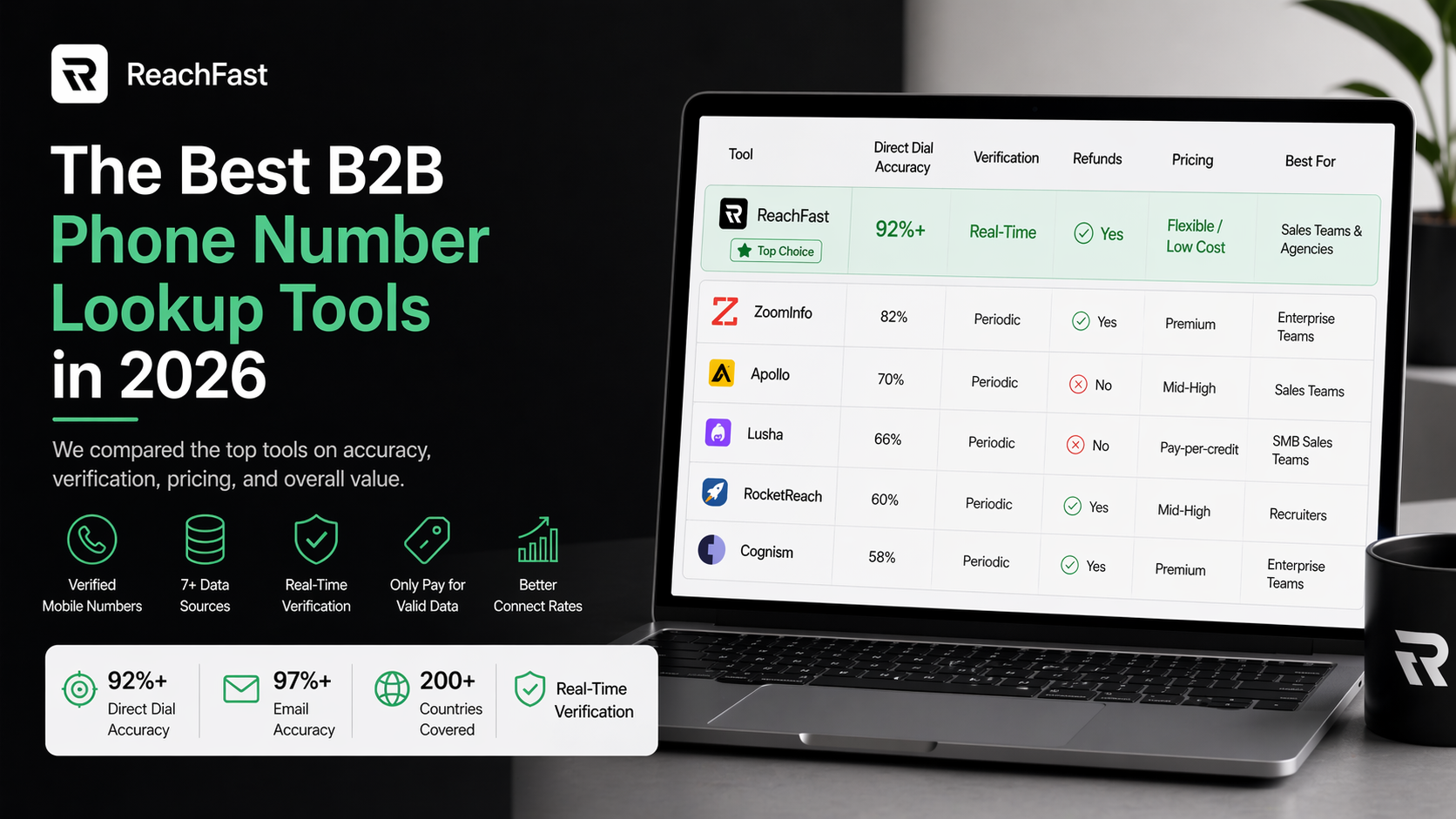
This is where ZoomInfo vs Apollo vs Lusha gets interesting. None of them is optimized specifically for verified personal mobile numbers at export. Tools built for that one job, like Reachfast, hit 92 percent plus direct dial accuracy because they verify each number against a live waterfall of seven-plus data sources the moment you export. If the number’s wrong, your credit refunds automatically. For phone-heavy outbound, that’s often a better fit than paying $20K a year for a tool that batch-refreshes quarterly.
Where Each Tool Actually Breaks Down
Every tool has a failure mode. These are the ones users hit most.
ZoomInfo’s failure mode: vendor lock-in. Common reasons users leave include high pricing, complex contracts, steep learning curves, and a need for more flexible or regionally-compliant data solutions Lusha. Once you sign the annual contract, you own it. Quarterly performance reviews don’t get you out of month nine.
Apollo’s failure mode: deliverability damage. Email accuracy averaged about 80 percent in testing. One in five emails bounced. That’s below the threshold for sustained cold outreach without deliverability risk. And once your domain reputation drops, every subsequent campaign suffers Cleanlist. Apollo gets you moving fast and can tank your sender score just as fast if you don’t run a second verification pass.
Lusha’s failure mode: volume scaling. Bulk operations are the worst use case. If you need to enrich a CSV of 1,000 leads, the per-credit cost adds up fast MillionPhones. The hover-and-click motion that makes Lusha great also makes it painful at scale.
Compliance: The Part Most Reviews Skip
For teams selling into Europe, the UK, or California, compliance isn’t optional.
ZoomInfo: SOC 2, GDPR, CCPA, and ISO 27701 certified. Documentation is thorough. Good fit for enterprise compliance teams.
Apollo: GDPR and CCPA compliant on paper. Implementation details are less transparent than ZoomInfo’s, and some users report patchy opt-out handling.
Lusha: GDPR, CCPA, SOC 2, and ISO 27701 certified. Strong compliance story, with clear documentation.
Cognism is worth mentioning as a fourth option here specifically for EU-heavy teams. It’s not in the big three but frequently swaps in for ZoomInfo in regulated markets.
Who Should Pick Which
After all the detail, here’s the clean answer:
Pick ZoomInfo if: you have a $15K+ annual data budget, a large sales team, and you sell primarily into North America. The depth and intent data earn the price at enterprise scale.
Pick Apollo if: you’re a startup or small team that wants data, email sequencing, and a dialer in one platform. Accept that you’ll need to run a second-pass email verification on anything you send.
Pick Lusha if: you’re an individual rep, a recruiter, or a small team doing hover-and-click prospecting on LinkedIn. The Chrome extension is the product, and it’s genuinely good.
Pick a specialized tool if: your motion is phone-heavy, you care about verified mobile numbers specifically, and you don’t want to sign an annual contract. Tools like Reachfast give you a waterfall-verified mobile from a LinkedIn URL, charge only for valid data, and refund bad numbers automatically.
Most teams end up with two of these. A cheaper daily-driver tool plus a specialist for phone data is a common combo. That’s also why the average B2B team now uses 2.7 providers at once.
One More Thing: The Hidden Cost of Picking Wrong
Before you sign anything, do the math.
A $15K/year ZoomInfo contract that delivers 85 percent accurate emails costs roughly the same per valid contact as a $500/year specialized tool with 97 percent accuracy. The sticker price lies. The real cost is the rep time spent dialing wrong numbers and the domain damage from bounced sends.
That’s also why annual contracts with no refund on bad data are a worse deal than they look. If 15 percent of your data is invalid and you can’t get credits back, you’re paying full price for 85 percent of a tool.
Frequently Asked Questions
What’s the main difference between ZoomInfo, Apollo, and Lusha?
ZoomInfo is the enterprise-focused data platform with the deepest coverage and highest price. Apollo is an all-in-one tool that combines data with email sequencing and a dialer at a lower price point. Lusha is a lightweight Chrome extension built for individual reps doing LinkedIn prospecting. Each one was built for a different type of buyer, so the “best” choice depends on your team size and motion.
Is Apollo accurate enough for cold email?
Apollo’s email accuracy in real-world testing lands around 65 to 80 percent, meaning one in four to one in three emails can bounce. That’s above the 2 percent bounce threshold where most ESPs start restricting your account. Most teams using Apollo run a second-pass email verification through ZeroBounce, Bouncer, or a similar tool before launching campaigns.
Which tool has the best phone numbers?
For US mobile numbers, ZoomInfo and Lusha typically beat Apollo. ZoomInfo has the deepest direct dial database at scale, Lusha has strong US mobile coverage for LinkedIn prospecting, and Apollo is thinner across the board. For teams that prioritize phone data specifically, dedicated tools like Reachfast or Cognism often outperform all three by using real-time multi-source verification.
Can I use Lusha for free?
Yes, Lusha offers a free tier that includes 5 credits per month. That’s enough to test the Chrome extension and see a handful of contacts. Beyond that, paid plans start around $29 per user per month for 480 credits annually. For teams doing more than a few lookups per week, the free tier runs out quickly.
How much does ZoomInfo actually cost?
ZoomInfo doesn’t publish public pricing, but real-world contracts typically start at $15,000 per year and scale up to $40,000 or more for larger teams. Pricing depends on seat count, data add-ons, and contract length. Annual commitment is required. Free trials exist through ZoomInfo Lite, which gives you limited monthly credits.
Is ZoomInfo worth it over Apollo?
At enterprise scale with heavy US coverage needs, yes. ZoomInfo’s intent data, conversation intelligence, and verified accuracy pull ahead. For most startups and small teams, the 10x price difference isn’t justified by the 15 percent accuracy lift. One sales manager put it bluntly: ZoomInfo’s data quality edge wasn’t worth the 10x price difference for their use case.
What about Cognism, UpLead, or Kaspr?
Cognism is a strong ZoomInfo alternative for EU-heavy teams thanks to its GDPR-first architecture and verified mobile data. UpLead is a solid mid-market option with real-time verification at a lower price. Kaspr is popular among European LinkedIn prospectors. For US-focused teams doing phone-heavy outbound, Reachfast is often a better fit than any of them because it verifies across seven-plus sources and refunds invalid data automatically.
Do I need all three tools?
Most teams don’t, but many end up with two. A common setup is Apollo for its sequencing and basic data, plus a specialist tool like Reachfast for verified mobile numbers. That combination costs less than a ZoomInfo contract and often delivers better phone connect rates.
Sources
- Apollo.io vs ZoomInfo: Data and Pricing Comparison — ZoomInfo
- ZoomInfo vs Apollo vs Clearbit: Pricing and Accuracy Compared — Cleanlist
- ZoomInfo vs Lusha 2026 — ColdEmailKit
- ZoomInfo vs Lusha vs Apollo vs MillionPhones — MillionPhones
- Top 10 Alternatives to Lusha for Sales Intelligence in 2026 — ZoomInfo
- Apollo.io vs ZoomInfo: User Comparison Guide 2026 — Fundraise Insider
- Comparison: Apollo, ZoomInfo, Lusha, Kaspr, Cognism — Compare-SaaS
- 10 Best ZoomInfo Alternatives and Competitors — Lusha