A rep wraps up a cold call. The prospect sounded interested, promised to “think about it,” and asked to be sent more details — but the only contact info on file is the mobile number that was just dialed. No email means no follow-up sequence, no case study, no proposal. The deal stalls before it really starts.
This exact gap shows up constantly in outbound sales, and it’s expensive. Cold calling alone converts at roughly 2.7% in 2026 according to Cognism’s State of Cold Calling research, while reps who layer in email and social touches see meaningfully higher response rates. The teams that consistently win the gap aren’t the ones with better talkers — they’re the ones with a repeatable system for turning a phone number into a full, verified contact record in minutes rather than hours.
This article breaks down exactly how sales teams find emails from phone numbers at scale in 2026, the tools they use to do it, and how to build the process into your outbound motion without adding another manual task to your reps’ day.
Key Takeaways
- Sales reps still spend a significant share of the week on research and admin instead of selling — Salesforce’s State of Sales research puts non-selling time at roughly 60% of a rep’s week.
- Multi-channel sequences that combine phone, email, and social outperform single-channel outreach by a wide margin — Convex’s research on outreach cadences puts the lift at up to 287% for sequences using three or more channels.
- Manual, one-by-one contact lookups don’t scale past a handful of leads a day; waterfall enrichment platforms do.
- The winning workflow is Import → Enrich → Reach: pull in numbers in bulk, enrich them with verified emails, then push straight into your CRM or sequencer.
- Speed matters as much as accuracy — leads contacted within five minutes convert at dramatically higher rates than those followed up with hours later.
Why Sales Teams Need Both a Phone Number and an Email
Phone-first prospecting has real advantages: a live conversation qualifies a lead faster than any email thread, and Aircall’s cold-calling research found that a well-timed direct call still gets picked up by a majority of mid-market decision-makers. But a single channel is fragile. Some prospects screen unknown calls and only ever respond to email. Others want something in writing before they’ll commit to a meeting. A rep who can only call is one missed connection away from losing the lead entirely.
That’s the real argument for treating phone and email as a pair rather than a choice. Gong’s research on cold outreach found that average reps send 344 cold emails to land a single meeting, while top performers using coordinated, multi-touch sequences book roughly 8x more meetings than the average rep working a single channel. The number itself isn’t the point — the point is that a phone number without a matching email cuts your available playbook in half before you’ve even started.
The Old Way vs. the 2026 Way
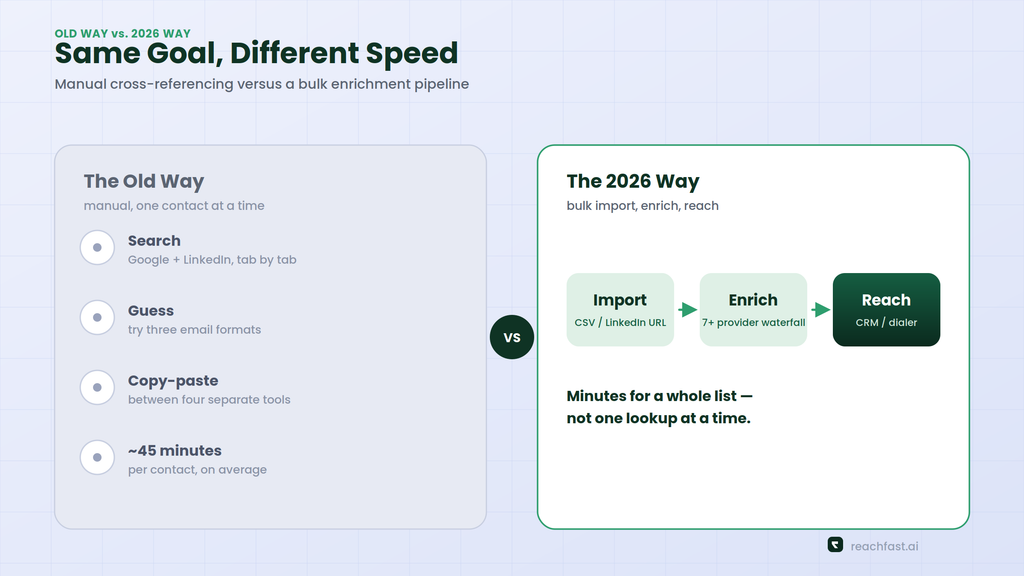
For years, “finding an email” meant a rep manually cross-referencing LinkedIn, guessing at email formats, running a Google search, and maybe pasting a name into three or four different tools before giving up or moving on. Landbase’s research on sales productivity puts actual selling time at just 28–34% of a rep’s week, with research and administrative work eating most of the rest.
The 2026 version of this workflow looks different because the tooling caught up. Instead of one database, modern enrichment platforms query several data providers at once — a method usually called waterfall enrichment — and return the first verified hit. Reachfast runs this process across 7+ data providers, verifying both phone numbers and emails at the moment they’re exported rather than serving cached, possibly outdated records. That’s the structural difference between a rep spending 45 minutes a day hunting for one email, a cost that shows up repeatedly in time-tracking studies of sales teams, and a rep pasting in a CSV before their first coffee.
Step-by-Step: Turning a Phone Number Into a Verified Email
- Capture the number at the point of contact. Whether it came from a call, a form fill, or a LinkedIn message, get it into your CRM immediately rather than a scratch note.
- Identify the person. If the number alone isn’t tied to a CRM record yet, a quick caller-ID or reverse lookup check gets you a name and, ideally, an employer.
- Match to a LinkedIn profile or company record. This is usually the fastest path to a confident identity match, especially for B2B contacts.
- Run it through an enrichment platform. Paste a single LinkedIn URL for a one-off lookup, or upload a CSV for bulk lists — Reachfast’s Chrome extension also lets reps pull contact data straight from an open LinkedIn profile without leaving the tab.
- Push straight into your CRM or sequencer. Export enriched contacts directly into Salesforce, HubSpot, or your outreach platform via API or native integration, so no one is copy-pasting between five tabs.
- Kick off the sequence immediately. The value of a fast follow-up compounds — see the next section.
Speed Is Half the Battle
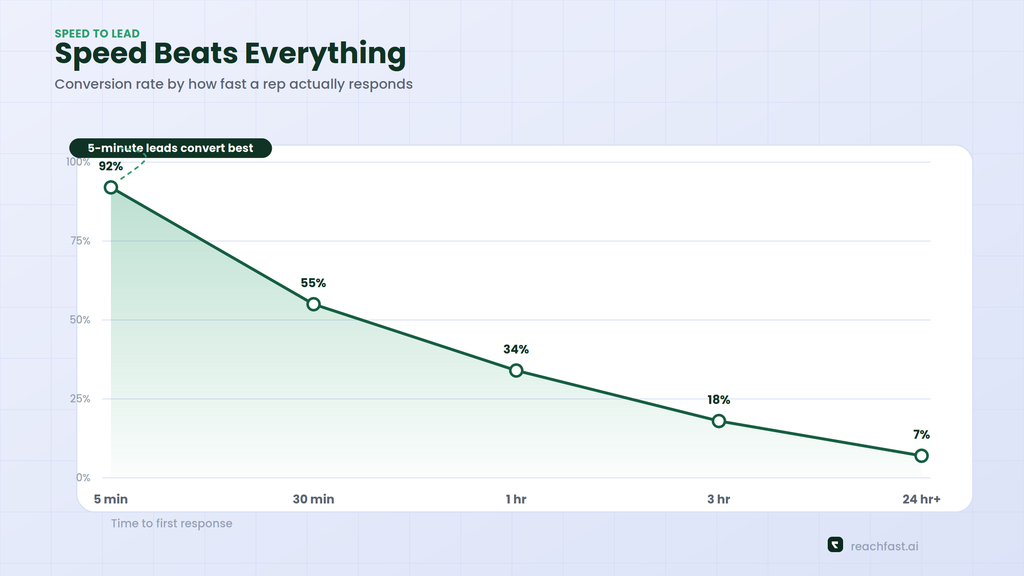
Finding the email is only useful if you act on it quickly. Chili Piper’s research on vendor response times found that more than 80% of companies take over five minutes to respond to a new lead, or never respond at all — and speed-to-lead is consistently one of the strongest predictors of conversion in B2B pipelines. Our own five-minute connect playbook and guide to designing SLAs for sub-5-minute follow-up both go deeper into building this speed requirement into a team’s actual process, not just its aspirations.
The practical implication for enrichment: a tool that takes a rep two minutes to get a verified email defeats the purpose if the lead has gone cold by the time the follow-up lands. Bulk enrichment ahead of time — enriching a whole list overnight rather than looking up contacts one at a time as calls come in — removes that bottleneck entirely.
Tools Sales Teams Use in 2026
| Tool | Known For | Where It Fits |
|---|---|---|
| Reachfast | LinkedIn-to-contact enrichment, 7+ provider waterfall, 100% accuracy guarantee | Turning a phone number or LinkedIn URL into a verified email and direct dial |
| Apollo.io | Large all-in-one contact database plus sequencing | Teams wanting prospecting and outreach in one platform |
| Lusha | Chrome extension, quick individual lookups | Fast one-off lookups while browsing LinkedIn |
| ZoomInfo | Enterprise-scale database and intent data | Large orgs with bigger budgets and ABM programs |
| Cognism | Strong EMEA coverage, documented GDPR compliance | Teams prospecting heavily into Europe |
If you’re actively comparing platforms, our breakdowns of Reachfast vs. Apollo.io and Apollo vs. Lusha cover the trade-offs in more detail than a summary table can.
Building This Into Your Actual Workflow
The tool only matters if the workflow around it holds up. A few things separate teams that get consistent value from enrichment tools from teams that buy credits and let them sit unused:
- Enrich in batches, not one lead at a time. Upload your weekly target list in bulk rather than looking up contacts reactively.
- Set a data freshness policy. Numbers and emails decay — job changes, carrier switches, and email migrations all break old records. Our outbound data hygiene checklist lays out a practical refresh cadence.
- Route enriched contacts straight into sequences. Every manual handoff between “found the email” and “sent the first touch” is a place leads go stale.
- Track source and consent basis for every contact. This matters for compliance (below) and for auditing which data provider actually converts.
- Review account-level context before the first touch. Enrichment gets you the contact; our guide to account research covers what to layer on top before reaching out.
Compliance for Sales Teams
Contact enrichment sits inside a real legal framework, and it’s worth building your process around it rather than bolting compliance on afterward.
GDPR generally allows B2B outreach under the “legitimate interest” basis in Article 6(1)(f) — no prior consent required, provided the outreach is relevant to the person’s role, you’re transparent about your data source, and you offer an easy opt-out. Regulators have imposed billions of euros in fines since enforcement began, so “we didn’t know” isn’t a viable defense at scale.
CCPA/CPRA now explicitly covers B2B contacts in California, and roughly twenty US states have their own comprehensive privacy laws in effect as of 2026 — worth knowing if your target accounts skew toward any specific state.
TCPA governs automated calls and marketing texts to mobile numbers specifically, with penalties of $500–$1,500 per willful violation. This is about how you contact someone, not how you found their number, but it directly affects any sequence that includes SMS.
Our guide to building a GDPR-compliant prospecting workflow walks through documenting legitimate interest and setting up opt-out handling end to end. For a broader regulatory picture across GDPR, CCPA, and the growing list of state laws, Unify’s compliance guide is a useful reference to keep your legal team looped in on.
What Changes When Reps Stop Hunting for Emails Manually
The ROI case here isn’t abstract. Time-tracking studies of sales teams consistently show reps burning close to an hour a day cross-referencing multiple tools just to piece together one contact’s details — time that comes directly out of the roughly two hours a day most reps spend actually selling, per research from Lead Forensics. Removing that manual step doesn’t just save time; it changes what’s mathematically possible for a rep to accomplish in a day.
Teams that combine bulk enrichment with a genuine speed-to-lead process tend to see the compounding benefit show up in two places: more first touches actually landing (because reps have both a number and an email instead of one or the other), and more of the deals in the pipeline moving because the follow-up happened before the moment of interest cooled off. For a deeper look at why phone-first data specifically closes gaps that email-only lists can’t, see our piece on the future of phone-first lead discovery, and our companion piece on why cold calls fail when the underlying data is wrong.
Frequently Asked Questions
How do sales teams actually get an email from just a phone number? By identifying who the number belongs to first — through a quick lookup or an existing CRM/LinkedIn match — and then running that identity through a waterfall enrichment platform that checks several data providers for a verified email.
Is this different from what an individual would do to find one email address? The method is the same in principle, but sales teams need it to work at volume — dozens or hundreds of contacts a week — which is why bulk upload, CRM integration, and API access matter far more for a team than for a single lookup.
How accurate is enriched contact data? It varies by provider and how the data is verified. Platforms that re-check deliverability at export time, rather than serving cached results, consistently perform better than static databases. Reachfast, for example, backs its phone data with a 100% accuracy guarantee and refunds credits for any incorrect number reported.
What’s the biggest mistake teams make with enrichment tools? Treating them as a one-off lookup tool instead of building them into a repeatable, bulk workflow with a fast follow-up SLA attached. The tool only pays off if the speed-to-lead process around it is solid.
Does this replace cold calling? No — it supports it. The goal is giving reps both channels so a missed call doesn’t mean a lost lead, not replacing the phone call itself.
Final Thoughts
The teams pulling ahead in 2026 aren’t necessarily making more calls — they’re making sure every call, every LinkedIn message, and every form fill turns into a complete, verified contact record within minutes. That’s the difference between a phone number that dead-ends in a spreadsheet and one that becomes a working multi-channel sequence.
Reachfast is built specifically for this: paste a LinkedIn URL, upload a CSV, or use the Chrome extension mid-call, and get a verified phone number and email back from a 7+ provider waterfall, backed by a 100% accuracy guarantee. If you haven’t already, our companion guide on how to find an email address from a phone number covers the individual-lookup version of this same process in more depth.