9 Best AI Recruiting Platforms in 2026 (And the Blind Spot They All Share)
There are, by most counts, well over 200 tools on the market currently marketed as “AI recruiting platforms.” Most comparison articles handle that problem by ranking all of them against each other on a single scale, which doesn’t hold up — a conversational screening bot built for hourly retail hiring and a talent-intelligence engine built for enterprise workforce planning aren’t competing for the same buyer.
This list skips the single-ranking approach. Instead, it covers nine platforms that are each genuinely good at something specific, tells you who each one is actually built for, and — at the end — walks through a limitation that shows up across nearly all of them regardless of category: finding the right candidate is not the same as being able to reach them.
How We Evaluated These
None of the platforms below paid for placement on this list, and none of them are ranked by which one has the flashiest demo. We looked at four things for each: what specific hiring problem the vendor built the product to solve, publicly available customer evidence (case studies, G2 and Capterra reviews) rather than vendor claims alone, how the tool fits with the ATS and sourcing tools most teams already run, and whether the vendor has published anything on bias testing or audit practices given how much regulatory attention this category is under in 2026. A platform that’s excellent at one job and honest about what it doesn’t do beat a platform that claims to do everything reasonably well.
How We Grouped These
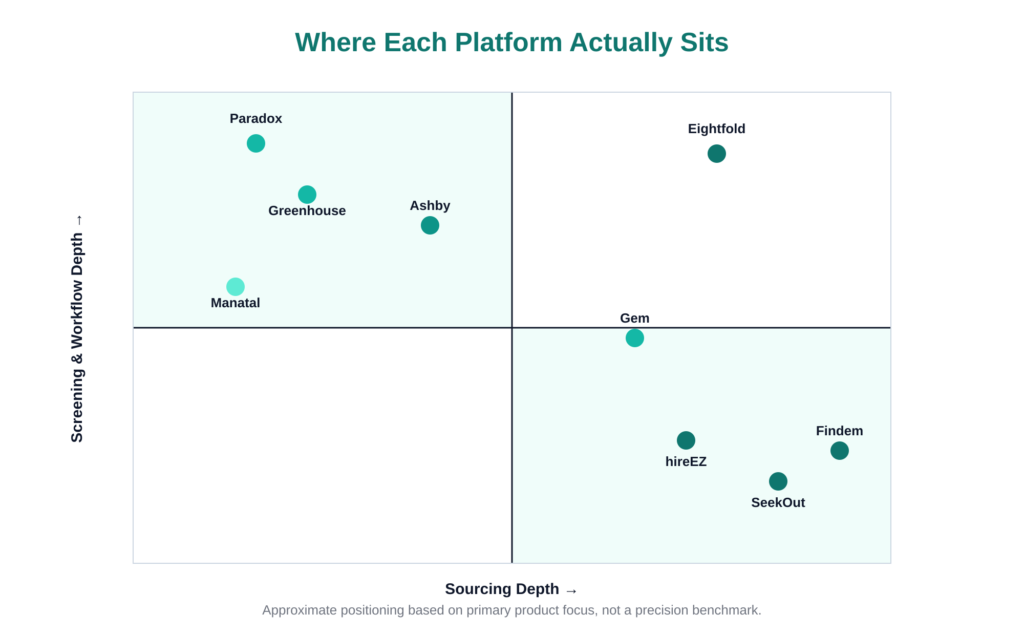
Rather than force-ranking nine unrelated products, it’s more useful to group them by what they’re primarily solving:
- Talent intelligence and matching: Eightfold AI, Findem
- Passive sourcing and outbound: SeekOut, hireEZ, Gem
- Conversational screening and high-volume hiring: Paradox
- ATS-native, structured hiring: Greenhouse, Ashby
- Budget-friendly, smaller teams: Manatal
1. Eightfold AI — Best for Enterprise Talent Intelligence
Eightfold takes the “match by potential, not keywords” approach further than most competitors. Its deep-learning models, trained on well over a billion career profiles, try to infer skills and career trajectory rather than matching resumes against a static job description. That makes it strong for internal mobility — surfacing existing employees who could move into a new role — in addition to external hiring.
Best for: Large enterprises managing external recruiting and internal talent mobility together. Where it’s weaker: Implementation is heavier than most tools on this list; it’s built for organizations with the internal resources to configure it properly, not a fast plug-and-play setup.
2. SeekOut — Best for Technical and Diversity Sourcing
SeekOut’s core strength is search depth. It indexes several hundred million public profiles, including developer-specific sources like GitHub, and is particularly well-regarded for surfacing hard-to-find technical talent and building more diverse candidate pipelines through its filtering tools.
Best for: Technical recruiting teams and any organization prioritizing diversity sourcing for hard-to-fill roles. Where it’s weaker: It’s a sourcing engine first — screening and scheduling are thinner than on full-funnel platforms.
3. Paradox (Olivia) — Best for High-Volume, Hourly Hiring
Paradox built its product around Olivia, a conversational AI assistant that texts candidates directly, answers their questions about a role, collects basic qualifying information, and schedules interviews — often within the same conversation. It’s the standard choice for large employers hiring at high volume in retail, hospitality, and healthcare, where speed-to-interview is the main bottleneck.
Best for: Frontline and hourly hiring where time-to-interview needs to be measured in hours, not days. Where it’s weaker: It’s not built for nuanced, senior-level hiring where the screening conversation needs real judgment rather than a scripted flow.
4. Gem — Best for Sourcing Plus CRM in One System
Gem combines outbound sourcing with a recruiting CRM, which matters more than it sounds — most sourcing tools generate candidates faster than recruiters can track relationship history with them. Gem’s pitch is keeping sourcing, nurture sequences, and pipeline tracking in a single system rather than three disconnected ones.
Best for: Recruiting teams doing serious outbound sourcing who need candidate relationship tracking built in, not bolted on. Where it’s weaker: It complements an ATS rather than replacing one, so you’re typically running it alongside Greenhouse or a similar system.
5. hireEZ — Best for Outbound Sourcing at Scale
hireEZ (formerly Hiretual) focuses on outbound sourcing across a wide range of public data sources, with an emphasis on automating the outreach sequence once candidates are identified, not just the search itself.
Best for: Teams running high-volume outbound sourcing campaigns who want sourcing and initial outreach handled in one workflow. Where it’s weaker: Like Gem and SeekOut, it’s a sourcing-and-outreach specialist rather than a full applicant-tracking replacement.
6. Greenhouse — Best ATS With Built-In AI
Greenhouse remains the closest thing the industry has to a default enterprise ATS, and its AI features — resume screening assistance, structured interview kits, and more recently, fraud and duplicate-application detection — are additions to an already-dominant structured hiring workflow rather than the main selling point.
Best for: Companies that want a proven, structured hiring process with AI layered on, and value the breadth of Greenhouse’s 500+ integrations. Where it’s weaker: It’s not a sourcing tool. You’ll typically pair it with SeekOut, Gem, or hireEZ for top-of-funnel candidate generation.
7. Ashby — Best All-in-One for Mid-Market Teams
Ashby packages ATS, sourcing, and analytics into a single product aimed at fast-growing mid-market companies that don’t want to stitch together four separate tools. Its reporting layer is a particular strength — recruiting analytics that would otherwise require exporting data into a separate BI tool.
Best for: Mid-market and scaling companies that want fewer vendors, not more specialized point solutions. Where it’s weaker: It doesn’t match Eightfold’s depth on talent intelligence or SeekOut’s depth on technical sourcing — the tradeoff for being genuinely good at several things instead of exceptional at one.
8. Findem — Best AI Talent Search Engine for Niche Roles
Findem’s positioning is similar to SeekOut’s — a talent search engine built on aggregated profile and company data — with a particular emphasis on attribute-based search (finding people by career pattern and trajectory, not just current job title) for roles where the ideal candidate profile is unusual or hard to describe in a standard job posting.
Best for: Sourcing teams filling niche or unconventional roles where keyword search consistently comes up short. Where it’s weaker: Similar to other sourcing-first tools, it’s a candidate-discovery layer, not a full recruiting workflow.
9. Manatal — Best Affordable Option for Small Teams
Manatal is one of the few products on this list priced and built for small businesses and boutique agencies rather than enterprise budgets. It covers core ATS functions with AI-assisted candidate scoring and recommendation, at a fraction of the cost of the enterprise platforms above.
Best for: Small businesses, startups, and staffing agencies that need AI-assisted hiring without an enterprise contract. Where it’s weaker: It won’t match the sourcing depth of SeekOut or hireEZ, or the talent-intelligence layer of Eightfold — reasonable, given the price difference.
Quick Comparison
| Platform | Best For | Category |
|---|---|---|
| Eightfold AI | Enterprise talent intelligence | Matching |
| SeekOut | Technical & diversity sourcing | Sourcing |
| Paradox (Olivia) | High-volume hourly hiring | Screening |
| Gem | Sourcing + CRM | Sourcing |
| hireEZ | Outbound sourcing at scale | Sourcing |
| Greenhouse | Structured ATS with AI | ATS |
| Ashby | All-in-one mid-market | ATS |
| Findem | Niche/attribute-based search | Sourcing |
| Manatal | Budget-friendly small teams | ATS |
The Blind Spot Almost All of Them Share
Notice the pattern across most of the entries above: six of the nine are, at their core, sourcing or matching engines. That’s not a criticism — candidate discovery is a genuinely hard problem, and these platforms solve it well. But sourcing and matching only get you to a name and a LinkedIn profile. None of these tools, on their own, guarantee you have a working way to actually contact that person.
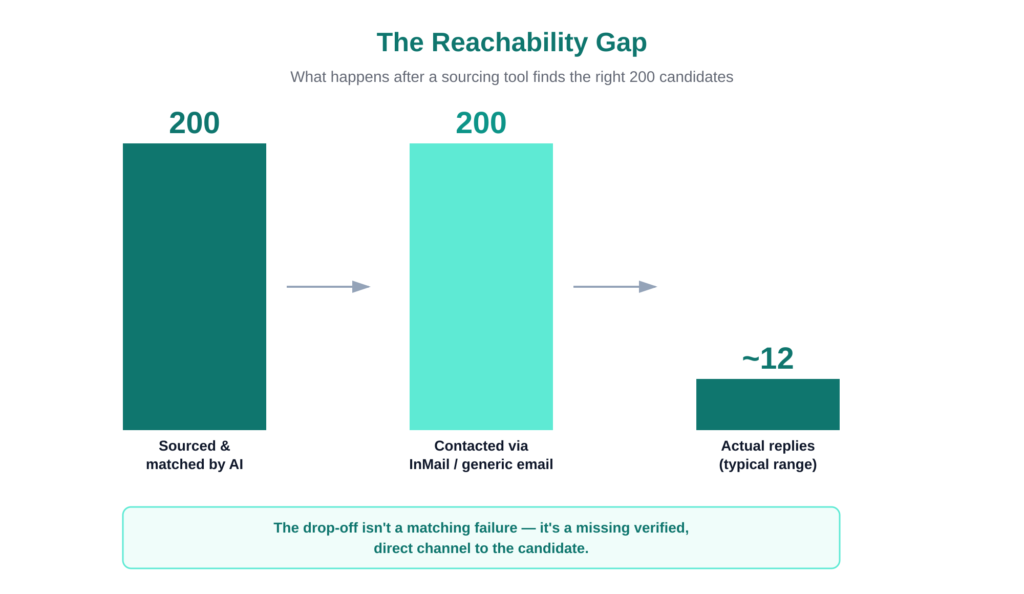
This shows up constantly in practice. A sourcing platform surfaces a candidate who matches every requirement. A recruiter sends a LinkedIn InMail. It sits unread for two weeks, because the candidate doesn’t check LinkedIn daily, or the recruiter has hit their outreach limit for the month. The work the AI platform just did — searching, scoring, ranking — evaporates, not because the match was wrong, but because there was no reliable channel to reach the person.
Run the math on a typical outbound sourcing campaign and the scale of the problem gets clearer. A recruiter using a tool like SeekOut or hireEZ might generate a shortlist of 200 strong candidates for a hard-to-fill role. Industry data on InMail and cold-email response rates consistently puts reply rates in the single digits to low teens for unsolicited outreach with no verified direct channel. That means the AI platform did its job on 200 out of 200 candidates, and the recruiter still ends the week with a handful of actual conversations — not because the sourcing was wrong, but because InMail and a generic work email are weak channels compared to a verified direct number or personal email.
The fix isn’t asking your sourcing tool to also be a contact database — that’s not what most of them are built for, and bolting it on rarely works well. It’s pairing the sourcing layer with a dedicated verified contact-discovery tool. We’ve covered the mechanics of this in more detail, including a comparison of LinkedIn phone number finder tools and how B2B and recruiting teams find emails from limited starting information.
Reachfast specifically focuses on this layer. It finds verified direct phone numbers and emails for 385M+ professionals from a LinkedIn URL — not a sourcing or screening engine like the nine platforms above, but the piece that turns a shortlist into actual conversations. It also adds filtering most sourcing tools don’t offer natively: candidates by open-to-work status, skills, certifications, languages spoken, and past companies, and hiring managers by recently changed jobs, company technographics, headcount growth, and revenue. It’s rated 4.5/5 on both G2 and Trustpilot, and it’s built for recruiters and sales teams who’ve already solved the “who” and are stuck on the “how do I reach them.”
Frequently Asked Questions
What’s the best AI recruiting platform overall? There isn’t a single “best” — it depends entirely on what you’re solving for. Eightfold leads on talent intelligence, SeekOut and Gem lead on sourcing, Paradox leads on high-volume conversational screening, and Ashby or Manatal lead on all-in-one affordability depending on company size.
Can small businesses afford AI recruiting platforms? Yes. Manatal is priced specifically for smaller teams, and several sourcing tools offer lower-tier plans. Enterprise platforms like Eightfold and Workday Recruiting are generally priced for larger budgets and custom contracts.
Do I need a separate ATS if I use one of these platforms? Depends on the tool. Sourcing-focused platforms (SeekOut, hireEZ, Gem, Findem) are typically used alongside an existing ATS. Greenhouse, Ashby, and Manatal include ATS functionality natively.
Why can’t AI recruiting platforms just include verified contact data themselves? Some are starting to add lightweight contact lookups, but verified phone and email data at scale is a specialized data problem — sourcing multiple providers, verifying accuracy, and refreshing records as people change jobs. Most recruiting platforms treat it as a feature to integrate with rather than a core competency to build from scratch, which is why dedicated tools in that space still exist.
How is 2026’s AI hiring regulation affecting which platform I should choose? It’s shifted the evaluation from “which tool screens candidates best” to “which vendor can show me their bias-audit results and explain how a decision was made.” With the EU AI Act’s high-risk obligations phasing in from August 2026 and litigation like Mobley v. Workday testing vendor liability directly, asking for audit documentation up front is no longer an edge-case request — it’s standard due diligence.
Bottom Line
Nine platforms, five different jobs, and one recurring gap. If you’re choosing among these, start from what’s actually breaking in your current process — slow sourcing, weak screening, or a scheduling bottleneck — rather than which vendor has the most impressive demo. And once you’ve picked a platform, don’t assume the sourcing problem and the contact problem are the same problem. They usually aren’t.
If you want the fuller picture of how this category works and what changed with 2026’s regulatory shifts, see our guide on what an AI recruiting platform actually is and how to evaluate one before you buy.