A recruiter posts a single role and 400 applications show up by Friday. Somewhere in that pile is the right person. Finding them by hand — opening each resume, cross-checking it against the job description, replying to the ones worth a callback — is the kind of work that used to eat entire weeks. That’s the gap an AI recruiting platform is built to close.
The term gets used loosely. Some vendors slap “AI-powered” on a resume keyword filter that’s been around since 2010. Others mean something closer to a full talent-intelligence system that sources, scores, and schedules without a human touching most applications. This guide breaks down what an AI recruiting platform actually is, how the pieces fit together, and — just as importantly — what changed in 2026 that makes this a very different category than it was two years ago.
What Is an AI Recruiting Platform, Exactly?
An AI recruiting platform is software that uses machine learning and, increasingly, large language models to automate parts of the hiring funnel that used to require a person: finding candidates, matching them to open roles, screening their qualifications, and coordinating interviews.
That’s a broader definition than “applicant tracking system,” and the distinction matters. A traditional ATS is mostly a filing cabinet — it stores applications, tracks pipeline stages, and logs communication. An AI recruiting platform does the filing cabinet’s job too, but it also makes judgment calls: which candidates look like a fit, which ones to contact first, how to phrase the outreach message, when to auto-schedule a screening call. Many modern platforms — Greenhouse, Ashby, Workday Recruiting — now blend both functions in one product, which is part of why the category has gotten harder to define cleanly.
The Core Components
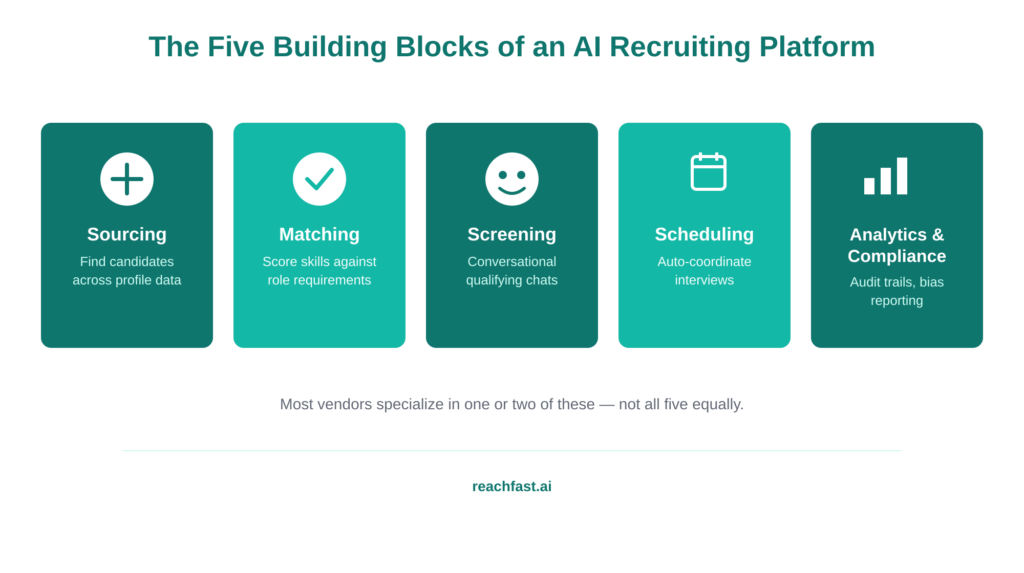
Strip away the marketing language and most AI recruiting platforms are built from the same five building blocks, even if individual vendors specialize in one or two of them.
Sourcing and candidate discovery. This is the search layer — scanning internal databases, LinkedIn, GitHub, or other public profile data to surface people who match a role’s requirements, including candidates who never applied.
Resume and skills matching. Instead of keyword scanning, most current systems use semantic matching: they try to infer actual skills and experience from a resume’s content, not just whether it contains the phrase “project management.”
Conversational screening. Chat-based or voice-based assistants that message candidates directly, ask qualifying questions, and route the ones who pass a basic threshold to a recruiter’s queue.
Interview and scheduling automation. Calendar coordination, automated reminders, and — on the higher end — AI-run first-round interviews with structured scoring.
Analytics and compliance reporting. Dashboards that track time-to-fill and pipeline diversity, and increasingly, audit logs built specifically to satisfy the regulatory requirements covered below.
Some platforms, like Eightfold AI, lean hardest into the first two — deep candidate-matching built on models trained across hundreds of millions of career profiles. Others, like Paradox, built their entire product around the third: a conversational assistant (Paradox calls theirs Olivia) that handles high-volume, hourly hiring for employers like large retail and hospitality chains. Knowing which piece a vendor actually specializes in matters more than the “AI-powered” label on their homepage.
AI Recruiting Platform vs. AI Sourcing Tool vs. AI Recruitment Software
These terms get used almost interchangeably in vendor marketing, which makes comparison shopping harder than it should be. In practice, there’s a rough hierarchy worth knowing before you start requesting demos.
AI recruitment software is the broadest term — it covers anything from a resume parser to a full-funnel platform, and vendors use it fairly loosely.
An AI sourcing tool is narrower: something built specifically to find and surface candidates, usually from public profile data, without necessarily handling screening or scheduling. SeekOut and Findem sit closer to this end of the spectrum.
An AI recruiting platform, as most people mean it in 2026, implies something closer to end-to-end: sourcing plus screening plus at least some scheduling automation, often bundled with an ATS or tightly integrated with one. When a vendor pitches you a “platform” rather than a “tool,” that’s usually the distinction they’re drawing, whether or not the underlying technology actually spans the full funnel.
Knowing which category a vendor actually falls into before the sales call saves you from discovering three demos in that the “AI recruiting platform” you’re evaluating is really just a sourcing tool with a scheduling add-on bolted on.
How It Fits Into the Hiring Funnel
In practice, a role moves through an AI recruiting platform roughly like this: the system sources or receives candidates, scores them against the role’s requirements, initiates outreach or screening for the top matches, hands qualified candidates to a recruiter for a human conversation, and then automates scheduling once both sides want to move forward.
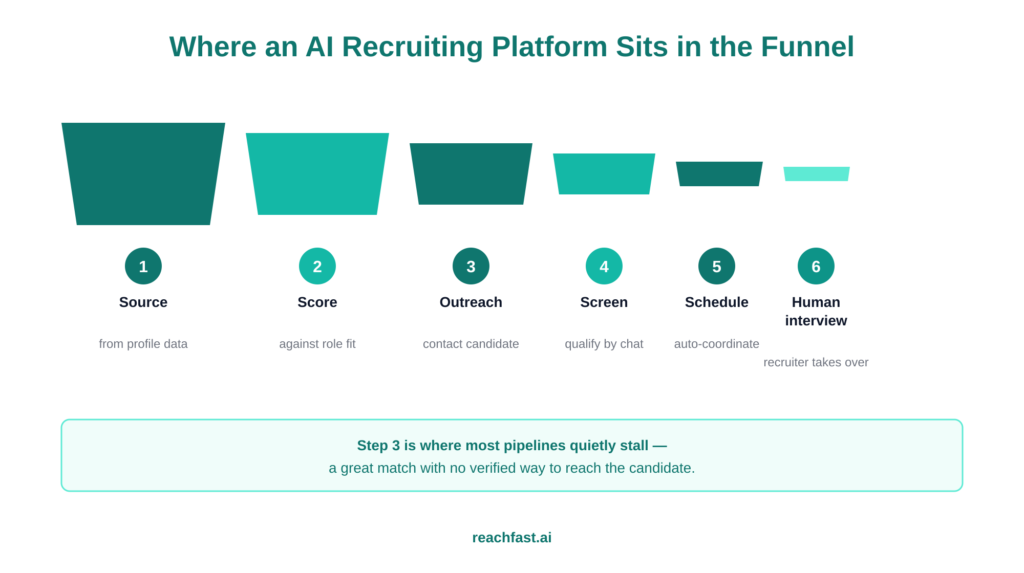
The promise is speed. Josh Bersin’s research on talent acquisition technology has pointed to AI-enabled hiring processes running two to three times faster than fully manual ones, largely because the sourcing and initial screening stages — historically the slowest part of the funnel — get compressed from days to hours.
The catch is that speed only helps if the system is matching well in the first place. A platform that quickly screens the wrong 50 candidates hasn’t saved anyone time; it’s just moved the bottleneck downstream, to the recruiter who now has to figure out why none of the “qualified” candidates are actually a fit.
What Changed in 2026: Regulation Caught Up to the Technology
For the first several years of this category’s growth, “AI recruiting platform” was mostly a product conversation. In 2026, it became a legal one.
The clearest marker is the EU AI Act, which classifies AI systems used in recruitment, candidate evaluation, and workplace performance monitoring as “high-risk.” Starting August 2, 2026, employers and vendors using these systems in the EU are required to run risk assessments, conduct bias testing, keep a human in the decision loop, and disclose to candidates when AI is involved in evaluating them. Non-compliance carries fines of up to €15 million or 3% of a company’s global annual turnover, whichever is higher.
In the US, the pressure is coming through both statute and litigation rather than a single federal law. New York City’s Local Law 144 already requires any employer using an “automated employment decision tool” to hire for NYC-based roles to commission an independent bias audit before deployment and annually after that. Other states have introduced or expanded similar notice-and-audit requirements, and Gartner has projected that by the end of 2026, roughly 85% of large enterprises will be subject to at least one AI-specific hiring regulation — up from under 30% in 2023.
The litigation side is arguably more consequential for how vendors build these products going forward. In Mobley v. Workday, a case in the U.S. District Court for the Northern District of California, a group of job applicants alleged that Workday’s AI-driven screening tools disproportionately disadvantaged candidates based on age, race, and disability. The court has allowed several of the claims to proceed, including certifying a collective action on the age-discrimination claim and, in a June 2026 ruling, rejecting Workday’s attempt to dismiss related state-law claims. The case is still ongoing and hasn’t been decided on the merits, but it already matters: it established that a hiring vendor — not just the employer using the tool — can potentially be held liable for discriminatory outcomes if its software functions as an “agent” of the hiring company. A related case, Kistler v. Eightfold AI, is testing a different theory — that an AI hiring platform’s candidate scoring can function as an unregistered consumer report, triggering separate disclosure obligations.
None of this means AI recruiting platforms are going away. It means “does this platform have a bias audit trail and can it explain its decisions” is now a procurement question, not a nice-to-have feature request.
Where AI Recruiting Platforms Still Fall Short
Even a well-built, fully compliant AI recruiting platform runs into a problem that has nothing to do with its matching algorithm: reaching the candidate it just found.
Sourcing tools are very good at identifying someone who looks right for a role. They’re much less consistent at supplying a way to actually talk to that person. A LinkedIn profile that matches every requirement is still just a profile if the platform’s only outreach channel is an InMail that goes unread for two weeks, or a work email that bounces because the person changed jobs six months ago. This is the point where a strong shortlist quietly turns into a dead pipeline — the AI did its job, and the outreach still failed.
That’s a contact-data problem, not a matching problem, and it’s usually solved by pairing the recruiting platform with a dedicated contact-discovery layer rather than expecting the sourcing tool to also be a verified phone and email database. We’ve written more on the mechanics of this — see our breakdown of how to get a phone number from LinkedIn and a compliance checklist for finding phone numbers on LinkedIn the right way, without violating LinkedIn’s terms or applicable privacy law.
Reachfast is one tool built specifically for that layer. It isn’t an AI recruiting platform in the sourcing-and-screening sense covered above — it doesn’t score candidates or run interviews — but it finds verified direct phone numbers and emails for more than 385 million professionals from a single LinkedIn URL. For sourcing specifically, it lets you filter candidates by criteria most ATSs don’t expose well: open-to-work status, skills, certifications, languages spoken, and past companies. The same filtering runs in reverse for outbound-focused teams — surfacing hiring managers by recently changed jobs, company technographics, headcount growth, and revenue — which matters as much for agency recruiters prospecting new client companies as it does for sourcing individual candidates. It’s rated 4.5/5 on both G2 and Trustpilot. Worth treating as a companion to whichever sourcing tool or ATS you’re already running, not a replacement for one.
What to Actually Evaluate Before Buying One
A shorter list than most vendor comparison pages will give you:
- What it’s actually built for. Sourcing, screening, scheduling, and full-funnel automation are different jobs. Few platforms do all four equally well.
- Bias audit and explainability. Ask for the vendor’s most recent audit results, not just a claim that “fairness is built in.”
- ATS integration. A recruiting platform that doesn’t sync cleanly with Greenhouse, Lever, or your existing ATS creates duplicate work instead of removing it.
- Where the candidate data comes from, and how fresh it is. Stale sourcing databases produce plausible-looking candidates who no longer work where the profile says they do.
- What happens after a match. If the platform surfaces a great candidate but gives you no reliable way to contact them, you’ve solved half the problem.
Frequently Asked Questions
Is an AI recruiting platform the same as an ATS? Not exactly. An ATS is primarily a system of record for tracking applications and pipeline stages. An AI recruiting platform typically includes ATS-like tracking but adds automated sourcing, matching, or screening on top of it. Many current products, like Ashby and Greenhouse, now combine both.
Is it legal to use AI to screen job applicants? Yes, but with growing conditions attached. Depending on where you’re hiring, you may need to run a bias audit (as under NYC’s Local Law 144), disclose AI involvement to candidates, or meet EU AI Act requirements if you’re hiring in the EU. Ongoing litigation like Mobley v. Workday is actively shaping what “compliant” looks like in practice.
How much does an AI recruiting platform cost? Pricing varies widely by vendor and scale — from a few hundred dollars a month for small-team tools to custom enterprise contracts running into six figures annually for platforms like Eightfold or Workday Recruiting. Most vendors don’t publish pricing publicly, so getting a quote usually requires a sales conversation.
Do these platforms replace recruiters? Not in practice. They tend to compress the sourcing and initial-screening stages, which frees up recruiter time for the parts of the job — relationship-building, closing candidates, judgment calls on borderline cases — that AI still handles poorly.
Where This Leaves You
An AI recruiting platform can meaningfully shrink the time between “role opens” and “role filled,” but only for the parts of hiring that are genuinely mechanical: sorting, matching, and scheduling. It won’t fix a bad job description, and it won’t reach a candidate who has no working contact information on file. Treat it as one layer of the hiring stack rather than the whole stack, and budget separately for the compliance and contact-data pieces that most vendor demos skip over.
If you’re comparing specific vendors rather than the category as a whole, our roundup of the best AI recruiting platforms in 2026 breaks down nine real products by what they’re each actually built to do — including the one gap almost all of them share.